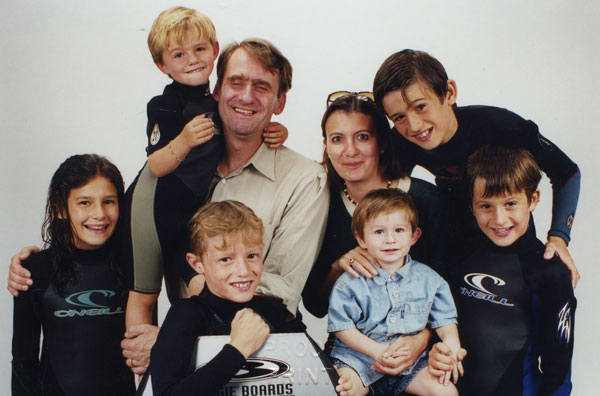
All of the children had wet suits that year. It was the fall of 1999.
And if you don’t recognize that Beach Boys tune, you clicked here by mistake!
Everybody went surfing except the parents, that is, and except Alex who was only a year old. Charlie, four, is on the left.
Yep, there’s a boogie board under him! Nick here demonstrates what they were all doing.
And actually, as any real surfer would immediately recognize, the children were all boogie-boarding rather than surfing. You boogie board on a boogie board (as opposed to a surf board) and you ride the waves where they break on the shore (as opposed to where they break off shore). Steamer Lane, one of Santa Cruz’s prime surfing spots, is to the right and behind them in the above picture. The Santa Cruz Wharf is behind them.
Tom (on the left) and Daphné boogie boarding on the same wave.
Daphné and Tom shared the same wave that same afternoon. Boogie-boarding is fun for everybody! From time to time, one or other of the children would go down to the beach and take on those breakers
Surfing came later, starting seriously in the summer of 2000. But it never became a constant preoccupation. In 2004, we still had two surfboards at home, but except for Nick (and his enthusiasm waxed and waned) they did not see that much activity.
Alban turned his focus to mountain bikes and the “15 foot drops” and “jumps” that can be done with them. We try not to look. He continued skateboarding into his twenties, but dropped the surfing.
Here is Charlie doing some wild boogie-boarding in May 2004: he had jumped off the sand dune (out of the frame on the left) on to the board floating in the creek, and is falling off backwards in the picture as the board flies forward. This is the creek that cuts through Capitola beach some years.
After Nick moved out in the summer of 2005, surfing seemed almost to stop, as far as we could see. He tried to keep it up, but working as a programmer and taking a full course load at junior college did not leave him a lot of time.
Alex mastering the boogie-board at Twin Lakes Beach in May 2004. He was six.
It’s actually a pretty scary sport, as anyone who has ever been tumbled by a wave while paddling offshore can testify. The same energy in the wave that makes riding it exciting makes floundering in it scary.
Also, surfing is also impossible to photograph from the shore with amateur equipment. Watching Nick a couple of times with camera in hand, we could never tell whether or not he was the subject in the viewfinder! The best surfing typically occurs a way off-shore. Here is an exception.
The result is that we have no real surfing photos. But living in Santa Cruz, California’s real surf city, we have to have a web page called “Surfing:” that’s the way it is! And the shots of boogie-boarding do give a feel of what fun it makes a visit to the beach.
Tom in a big wave on a boogey-board at Twin Lakes Beach, May 2004. He’s in there all right, just getting a little bounced around!
Boogie-boarding has stood the test of time, and has given us some great photographs of our children having fun.
Charlie’s turn at Twin Lakes in May 2004. That was a pretty serious wave, as you can see from the comparable one breaking behind it.
Sounds easy doesn’t it? But it took more than three years for our furniture to move from La Bellanderie to Santa Cruz. Why?
This used to be a nice, solid inner-spring sofabed. It cost about $1,000 in New York City in 1983, and had lasted several house moves, including one international move, but not the Tison treatment. It’s here at the top of the page because it really was strongly built piece of furniture, and yet its back was broken. An accident?
First and most importantly, Tison S.A., the furniture moving company based in Coignières (78), west of Paris, which Marie-Hélène picked to do the move for us, was crooked. In trying to con us in 1997, Tison succeeded in depriving our children of all their toys and most of their clothes for over three years. Its President, the chief con artist, was one Arnauld Bourlé. There are several examples of Arnauld’s con artistry on this page.
After realizing that we were being conned, and to help us recover our furniture, we called in “La Chambre Syndicale du Déménagement,” a French self-regulatory organization. As one of this association’s jobs is to protect moving company customers, and as our furniture was being held for ransom by Arnauld Bourlé in Tison’s warehouse to blackmail us into paying amounts that should never have been due, we asked them for help. We told them basically what is on this page, explaining Bourlé’s various cons to them. Associations like these typically know who their bad apples are, and know what the basic cons are. It is their job to know. The Chambre Syndicale did absolutely nothing for us.
This was just a TV table. But it wasn’t any more!!
Our final fallback, after all was delivered with the inevitable damage of three years of being moved around, was SIACI, a French insurer of goods in transit, now called DiotSIACI (I think). We had paid substantial premiums to SIACI (to the tune of about $1,500!) to insure our furniture in transit. They weaseled and schemed and stalled and finally did not pay us one red cent in compensation, despite all the damage we had suffered in diverse ways.
* * *
Here’s more detail. We were trying to do a lot in a short time. Our wedding was on May 24th, and we were scheduled to fly to New York on June 23rd. As always happens when you’re self-employed, work picks up when you need more time for personal matters (no complaints there: it pays the bills), and I barely had enough time to do everything.
The major collective task was packing and arranging to move our furniture to California. I had accumulated mine from my my own home (what Sunshine left behind when she moved out), from my mother’s house after she died and from Great Aunt Alice. Marie-Hélène had accumulated hers from her mother after she died, from her apartment shared with Pierre, and from her Tante Lucette.
The famous Tison estimate for a maximum of 64 cubic meters of furniture, “in the opinion of Arnauld Bourlé.”
In short, we had a lot of furniture by this time, in a big house. We didn’t yet have a home to move it to, but were counting on having all the furniture delivered to the Port of Oakland and having it collected by a local moving and storage company once we’d found a place. A bit messy, but not too bad, all things considered. The cost risk we thought was manageable, the warehousing in Oakland or Santa Cruz.
The overall con evolved slowly, inexorably. With the gift of hindsight, it was all so clear. Sitting in our bare and empty house in Santa Cruz, looking at the documents and trying to get our furniture back from Tison’s warehouse, where it was being held hostage, it became clearer and clearer.
This bonnetière, one of Marie-Hélène’s proudest pieces of furniture, visibly suffered.
Arnauld Bourlé sweet talked Marie-Hélène and gave her an estimate for loading a container and shipping it to Oakland. I was in Paris working the day that he visited to make his estimate. It was a little lower in price than the other estimate that we obtained, although not much. We had used the other company before, and had been satisfied. But expenses were mounting up, and price won the day. We paid Tison the two requested deposits.
VAT is called TVA in French. It is one of the line items in the box lower left. If we had paid that almost 10,000 francs on the day that we left, Tison would have had no duty to pay any of it to the government. In short, Bourlé would have made another 10,000 francs for nothing. Of course, it would have been a fraud, but not the only one in this story.
The estimate itself read “volume of 64 cubic meters maximum in a 40 foot container, according to Mr Bourlé’s visit.” Marie-Hélène, who had escorted Bourlé around La Bellanderie, told me that he had expressed a little concern that perhaps we had a bit more furniture than the 40 foot container would hold. We had been planning on leaving some things in France in any event, things like appliances that would not work on US electricity, and arranged with Bourlé for 10 cubic meters to be shipped to Marie-Hélène’s Oncle Alain in Autun. As Bourlé had confirmed a volume of 64 cubic meters in writing, we felt comfortable that arranging to take an additional 10 elsewhere would cover us against any underestimate of the volume.
Then on the final day of the move (the men were in the house packing for three days altogether), amid the insanity of trying to inventory and complete the packing of a 4000 square foot home, Bourlé’s men “discovered” that all did not fit in the 40 foot container supplied, even when 10 cubic meters was separated out and loaded into a separate van for delivery to Autun.
The men did not appear to be at all surprised.
This was Charlie’s changing table before we left. Of course, by the time it was delivered, over three years later, Charlie no longer needed to be changed. We had to buy another one for Alex while we were waiting for delivery of this one. In a way, you could say the fact that it was broken in transit didn’t matter.
We were frazzled and worried because not everything had made it into the container, but still aware enough not to pay all of the balance. Our alarms were going off. We paid the rest of the cost for Autun (all that left correctly, if without the inventory that Tison was supposed to prepare), but withheld 10,000 francs of the US balance (about $1600) pending clarification.
Two other events at the end of that frazzled day added to the number of alarm bells ringing in our heads. First, the final invoice for the US shipment added VAT, which was not due on a shipment to the US. If I wasn’t a business lawyer with some familiarity with VAT, I would never have known that. As it was, I ignored the 10,000 francs (again about $1,600) in VAT when calculating what to pay. Imagine someone less versed in the intricacies of French taxation, confronted with an invoice at the end of an insane day of organizing and separating and packing: that person would likely have paid it in full. Arnauld Bourlé apparently had several possible cons covered. If one or two failed, he had more up his sleeve.
The second event completed the day. Bourlé had asked us to obtain export documents from the appropriate government agencies and have them ready to give to his driver when he left pulling the container. The principal document was (and you could have guessed this!) confirmation from the local fisc that we had paid all taxes due. The driver refused the documents, which we had scurried around collecting, as did his men. We asked the British Airways counter person at Heathrow Airport in London (our flights went CDG-LHR, and LHR to JFK) to send them for us as we rushed through on our way to New York. They did get to Tison, although Bourlé of course claimed the contrary.
Here’s one of the first invoices we received after arrival in California. Bourlé got this one to us fast! It covers only the additional 20 foot container that Tison was insisting we would need to pay for. $3,500.
Upon arrival in California we received faxes and registered letters billing us for one or other (or more) of (1) the additional 20 foot container that would be needed, said the letter, to ship the balance of the furniture for Oakland that did not fit in the 40 foot container, (2) shipment of the initial 40 foot container to Le Havre (where it could not be loaded onto a vessel because of the “missing” customs documents) and back, and (3) storage of our furniture at Tison’s warehouse (where it was never supposed to go) during the ensuing period.
The amounts being invoiced were pretty significant. We had paid 38,000 plus francs toward the estimated 48,000 plus francs for the US move (and 5,000 francs for the move to Autun). Just the additional 20 foot container was going to cost us an additional 21,840 francs (excluding insurance), around $3,500. The back and forth to Le Havre of the original container was invoiced at over 23,000 francs (almost $4,000). Another 15,000 francs (about $2,500) covered “deposit of the container in our warehouse” and the first two months of storage there.
That’s $10,000, on top of the initial $8,000 that we had paid! Then we started receiving regular invoices for storage, invoices that increased every month.
Would Tison have settled in late 1997 for an amount below the aggregate of these early invoices? Perhaps. But the amounts were just too high, it took me nine months to find a real job in California and the balance of mum’s estate, which I had been using to cover emergencies such as this, had been the deposit on our home. We simply didn’t have the $6-7,000 that such a settlement might have arrived at. It wasn’t worth trying for.
Whoops! This was actually more serious than it looks. Several of these dark glass doors were broken or cracked, rendering unusable the entire (rather nice) piece of furniture of which they were a part.
Plus, I have to admit that I was furious and in no mind to accept this kind of blackmail. It offended the English part of me. As we got further into the dispute, the extent of Arnauld Bourlé’s deliberate and planned cheating became clearer, and infuriated me.
Here was the basic con. Immediately we contacted Tison, right around the time he visited La Bellanderie to give his estimate, Bourlé asked his shipping agent in Le Havre for a quote for 85 cubic meters of furniture to the Port of Oakland. Unbeknownst to us, the agent apparently gave him that estimate.
In early July after we arrived in California, Bourlé explained in a fax that his written estimate to us of 64 cubic meters, the amount that he said fit in a 40 foot container, resulted from Marie-Hélène’s request to him to limit what we shipped to the US to 64 cubic meters to fit in that container. She had not wanted to pay the excess for the balance, his letter explained. If that excess was the $3,500 he claimed in his simultaneous invoices, that might have been logical. In light of the final amount that we paid for the excess, and why it was so much lower at the end, her alleged request made no sense. But I’m jumping the gun!
Here is that furniture at Le Tahu in its prime.
Even then, this basic con did not appear to be a very good one. The language that Bourlé used in his estimate made it clear that it was his estimate (“according to Mr. Bourlé’s visit”), and did not mention any limit on the volume made at the request of his client. He obviously should have made such a mention, along the lines of “total volume = 85 cubic meters; volume for shipment = 64 cubic meters, as requested by client.”
Otherwise, what was to protect his company against any claim from us based on his own blatant error in the written estimate that we received? Of course, he couldn’t have written enough to protect his company at the time, because that would have alerted us in advance to the con. The language that he actually used was proof of the con for anyone bright enough to see it.
There are other common sense arguments that revealed the con. What woman who is emigrating will ask that one quarter of her personal effects be left in limbo, even to save a few thousand bucks? Wouldn’t she have obtained an estimate for storing or shipping this quarter elsewhere? Well, guess what, she did arrange for shipment elsewhere of more than she believed would be left out of the container. (By way of a sidebar, most of what was shipped to Autun, apart from the French appliances, was my stuff that Marie-Hélène didn’t like: this was normal feminine behavior!) She didn’t arrange for more to be shipped to Autun or put into storage because we had no idea of the total volume.
Check this out! The final Tison invoice (March 2000) before the court entered its judgment: over $25,000!! On top of the $8,000 that we’d already paid back in 1997!
But ultimately common sense didn’t matter. The mere fact of preparing his con by having his shipping agent give him an estimate for 85 cubic meters caused the court to believe Bourlé, on that topic at least. This was not the smartest court in the world. Neither was it the fastest. How long did it take this Versailles court to order Tison to deliver our furniture? Almost three years!
We had tried for a more urgent decision from the Court, seeking an order early on that the furniture be moved here promptly pending resolution of the dispute. But the Court had found questions of fact to be resolved, and thus refused to order the furniture to be sent until full exposure of these facts. So we waited for three years.
But I shouldn’t badmouth the court. It did smell a fairly hefty rat here, the diminutive and dapper M. Arnauld Bourlé! That was Marie-Hélène’s description: I never met the man. It found that he had lacked diligence in obtaining the required customs documents from us. I’ll say: having his own people refuse them certainly lacks something!
Accordingly, the court held each of us and them half responsible for what happened and ordered us to pay Tison an additional $1,500 for delivery of the 64 cubic meters. You could hear the sigh of relief all over Santa Cruz! Of a final invoice of $25,000, we only had to pay $1,500. If that’s how you split the difference, I’m all for it!
My dad brought five of these century-old English contracts home from his office while I was at law school: nice touch! They were contracts from his company’s past. Mum framed them so that both front and back were visible. Not a cheap framing job. Fortunately, only one of the five was broken by Tison.
Which brings us to the final con, or should I say the final element of the first con. Throughout the process, Tison claimed payment for an additional 20 foot container to move to the US the balance of our stuff that would not fit in the initial 40 foot container. We discovered soon after our arrival in Santa Cruz that there was such a thing as a “high top” container, and we later ascertained that it holds about 76 cubic meters. Doing the math in our case, assuming as Tison claimed after the event that there were 85 cubic meters of furniture in our home, after 10 moved to Autun that left 75. Did we need a second container? No, all should have fitted in one 40 foot “high top.”
One of Marie-Hélène’s beautiful heirloom mirrors, a little the worse for wear.
But we didn’t know for sure until after the court’s judgment, which left the treatment of the remaining 11 cubic meters to the parties to work out. Tison, by now affiliated with UTS, a more reputable group of moving companies, proposed that we paid 4,000 francs, less than $700, to include all of our furniture in one high top container. That was explicit in their settlement proposal: we would only need to pay $600 more if the remaining 11 cubic meters was shipped with the original 64. This offer was not made by Bourlé personally, by the way.
You guessed it: all arrived in the fall of 2000 in one high top container! The whole circus had been completely unnecessary, uniquely designed to con us. Even if 85 cubic meters had been the initial estimate, then after taking out the stuff for Autun, a high top container could have taken everything as arranged to the Port of Oakland in June 1997.
To summarize the bare bones of the more serious cons: (1) there was never any need for a second container, even if Bourlé had told us about the 85 cubic meters as well as his shipping agent, just a higher container of marginally more expensive cost, (2) refusing or losing the export documents, which required (a) shipment back and forth to Le Havre and (b) deposit of the container at the warehouse and ensuing storage charges. I doubt that shipment to Le Havre ever happened, in retrospect, because the driver refused export documents (and no driver leaves for a port without export documents) and because such a shipment would have required Tison to pay third party costs, costs which it might never obtain from us and never did in fact obtain from us. My guess is that the container went straight from La Bellanderie to Tison’s warehouse, and that the whole Le Havre story was contrived to bolster the additional amounts that Bourlé claimed from us. A reminder of those amounts: (1) about $3,500; (2)(a) about $4,000 and (2)(b), about $2,500.
* * *
Here is the first page of the insurance company’s expert’s report on the damage the shipment suffered.
As it was, when the container arrived it was holiday time at our house! There was just so much stuff. We’d been living for so long with rented furniture, cheap things that we’d bought to tide us over until our furniture arrived and even other people’s cast-offs: we felt rich and royal as we unpacked out own things, which are themselves far from rich and royal.
It took days to move the furniture inside, weeks to empty all the myriad boxes. There were things that we’d forgotten, and things we didn’t want to remember. All of the children’s clothes had been outgrown, of course, and their toys were no longer age-appropriate.
But there was a ton of everything. I was thrilled to recover my cranky old bicycle and my old LPs and musicassettes. We all found things that felt like old friends. Music, books, posters, rugs, you name it. It was such a treat that I would plan to empty another box that evening or the coming weekend, just for the sake of it. Furnishing our home, finally, went on for months.
Every cloud has a silver lining. Marie-Hélène made a trip alone to Paris in February 2000 to help our lawyer (he had been unwell) at the court hearing. She was able to meet up with Faby, Maeve and Fiona at the airport, one day before Faby’s third daughter, Leah, was born.
It had been over three years. We had left a little food in the wardrobe boxes, not perishable, but with a view to recovering it when it arrived, in a few months. Strains of green stuff had been generated in some of the packages, which we tried not to examine as we jettisoned them!
Then there were my suits, which had all shrunk a couple of sizes despite being 100% wool. This we attributed to dampness in the warehouse where their wardrobe box had been stored. I certainly hadn’t put on any weight over those years, despite having given up smoking in January 1998!
One of the children’s favorite toys that didn’t make it through the ordeal: the ping-pong table.
* * *
Stories like this one always seem to have a sorry footnote. On many occasions, like this one, that sorry footnote involves an insurance company acting in bad faith.
After the furniture was delivered, we needed to deal with the damage. Not surprisingly, after having been packed and unpacked twice (from the smaller container to Tison’s warehouse, and from Tison’s warehouse to the high top container), there was some breakage. The insurance company’s own experts visited us to survey and assess the damage, and by Christmas 2000 had it all listed. How much damage did the insurance company’s own experts identify? Between $17,000 and $25,000. And that did not include the missing items, which we had a nearly impossible time remembering in the absence of a complete inventory. Did I mention that Tison’s men did not complete their inventory as they loaded? You could have guessed that too, right?!
There were odd things missing, a box of tools, a box of videocassettes, a box of crockery, that sort of thing. I’m tempted to describe it as normal wastage over three years in a warehouse. The one thing that really upset me was the box of videocassettes. Mum had recorded the Beatles’ Anthology when it played for the first time on British television in several weekly installments in 1995, the year before she died. The recordings weren’t great, and there were one or two episodes missing, but obviously they meant a lot to me. Even the replacement cost of these lost items was not included in the insurance company expert’s report.
Of course, the report also did not include all the money we had been obliged to spend outfitting the entire family and our six-bedroom home for the whole time that our furniture was withheld. Think about how much that involved.
Christmas in a house with no furniture! This was our first year there, 1997. The house remained bare, uncluttered, through September 2000.
SIACI, the insurance company, waffled and stalled and negotiated and asked for more information, estimates to repair what was damaged, that sort of thing. But they seemed in their obtuse bureaucratic way to be approaching a settlement, and that kept our guard down. Finally, when we started getting impatient and wrote yet another demand letter, we discovered that if we didn’t sue the insurer before the first anniversary of delivery, it was too late. It was too late already: SIACI had successfully waffled and stalled for a year, and now were in the clear.
* * *
The two participants in this story who are really and truly the scum of this earth, as the story itself proves, are M. Arnauld Bourlé, who takes the cake for the sheer diversity of his con artistry, and DiotSIACI. Watch out for both of them if you ever move furniture in France!
Tom celebrating his 5th birthday at Disneyland Paris in October 1994, with Nick in the picture and the rest of us around the table, all courtesy of Grandma Stock. She offered us all annual passports during that visit, and during the ensuing two years we all fell in love with the Wonderful World of Disney! Goofy is hugging both boys in the California Grill, and Marie-Hélène’s arm is poised to prevent some pending calamity!
Tom was born in Paris in the same week in 1989 that the Loma Prieta earthquake shook the Bay Area. The World Series was in progress, with the players on the ball park warming up when the whole ball park moved and the stands lurched and swayed. There was a lot going on that week! Chrystie, his maternal grandmother in Palo Alto, likes to remind Tom that he is her “earthquake boy.” This nickname may also have a little to do with his direct and powerful approach to the world.”Hello world: it’s Tom!”
Tom next to the graves of his ancestors. The photo was taken in 1994. As the gravestones say, two of them were called Thomas. They’ve been gone a long time. I never even knew my grandfathers. Perhaps as a result, I occasionally follow up on other ancestors. The London cemetery that the graves are in had been renamed years ago and “renovated” recently, but somehow these graves survived. Not even knowing if the graves were there, or where they were if they were, we bumped right into them just strolling around.
His birth itself was not the simplest. Within an hour after he arrived on this earth, the doctor diagnosed an infection, and promptly put him into an infant intensive care ward. A reasonable precaution: the only problem was that the hospital where his mom had given birth did not have an infant ICU. So he was transferred a couple of miles away to a hospital which did in the 13th arrondissement. His mom stayed where she was. Every day, I visited his mom and then walked the sidewalks across town to visit Tom. He was inside a plastic incubator to protect him from other ambient infection, and on an antibiotic intravenous feed to cure the one that he had. I couldn’t touch him or hold him, and neither of course could his mom, who was still miles away in her own hospital bed. That part was hard. I would stare at him hoping that he could feel me there, and when Nick was with me I would hold Nick up so he could see who was in that transparent plastic box.
Water has always been a source of pleasure for Tom. This one was taken at the pool at a London Airport Hotel in August 1994 on the day that I scraped my nose on the floor of the pool while diving in. Ouch, more for the embarrassment than anything else! The children, of course, behaved much more rashly, and did not get a scratch.
I don’t know how much he was conscious of his solitude in that incubator for the first week of his life, but I do know that he has a lot of fight in him. Tom is a very tough nut to crack.
Opening Christmas presents in le Tahu in 1994: happy day!
In part, that must have come from his early years. For one thing, his older sibling is Nick! That’s a challenge right there. Not that Nick isn’t kind to his little brother, which he is and was starting very young. But he also was not entirely happy with learning to share. Every older sibling has that problem early on, the transition from being the only subject of all that parental affection to playing second fiddle, and second to a more dependent and needy little person at that. In this case, I remember noticing that three or four of Tom’s first birthday presents were broken within a few days! Could have been Tom, could have been Nick, could have been nothing but poor quality merchandise: I’ll leave it at that.
Tom with Nick in the back garden at Grandma’s house in Marlow, around Christmas 1991.
Tom also arrived right in the middle of a parental conflict zone. Certainly not his fault. But his mom Sunshine and I had a deal when we moved to Paris, a simple deal: we would return to California after a few years. When she was pregnant with Tom in early 1989, she changed her mind, and announced that she would never return. Months, years of arguments and mutual reproaches ensued. I had already done my part of the bargain, finding a job in Paris and moving her there. I always felt like an outsider in my new home town, and now she was giving me no choice but to stay there indefinitely. Well, there was a theoretical choice. I could return alone to California and leave my young sons in Paris. That was simply not a practical alternative.
Nick, Tom and me in Sunshine’s apartment on la rue Boulard. She and I had been apart for almost a year, and I was living in a maid’s room a couple of blocks away. As I had left the law firm, I was spending more time with the boys despite the separation.
It was a debate that continued for years, and Tom arrived right as it was getting rolling! Dealing with Nick on the one hand, and with his feuding parents on the other, must have toughened him up. More significant perhaps for baby Tom was that from the age of about eight weeks, he spent every weekday first with a “nourrice,” a state-licensed child care person who looked after him and several other babies in her home. Both Sunshine and I had demanding legal jobs, and neither of us was able to take a prolonged maternity or paternity leave.
During a visit to California during the summer of 1993, we had a squirt gun battle in Palo Alto at his grandfather’s house.
Upon occasion, one of us would see his life at the nourrice’s, while picking him up for a medical appointment – French medical care for newborns is impressively thorough and almost free – or for a long weekend. The nourrice was a sweetheart, as you would expect of a woman making her living out of looking after babies. Yet every time I picked Tom up early, he was in front of a TV. She explained that he was happier that way, which I think meant quieter and more easily occupied, but he would have spent less time in front of a TV at home.
Tom likes sand. Here he is rolling around on the beach during the summer of 1992. There’s a cute anecdote around this photo. Tom had met Alban by this time, but had only spent a little time with him. They were born only three weeks apart, but in very different worlds. There is a photo of Alban on his “young Alban” page taken the same summer doing exactly the same thing in the sand!
At the end of the nourrice’s workday, around 4 or 5 pm, another child care person whom we had engaged would come to collect him from her home, and bring him and Nick to our home and feed them and play with them. On warmer days, the boys might be taken to the local playground, the “square de la mairie,” for a little outdoor entertainment. We found good people for this job, and paid them relatively well compared to our French peers. Tom was with Nick, his older brother, during these late afternoons. Either mom or dad, the first parent, would arrive home at maybe 7 or 8 pm, maybe later when there was pressure at work, to relieve the second child care person. Finally. From 8.30 or 9 in the morning until at least 7 or 8 in the evening, Tom was with a professional child care person.
Almost two years old, and playing at the local playground, the Square de la Mairie.”
France is a great resource of child care, even infant care, for working couples, but you have to wonder what so much separation from his parents at such a young age does for the child. That’s a comment on the parents, of course, more than on the wonderful institutions which allow them to raise their children in part by surrogates. The way that Sunshine and I lived was an inevitable result of believing that we were entitled to everything, an interesting career, children, the works. We were grateful that Paris was set up for people like us and our children. I wouldn’t do it differently if I had it to do over: there’s no justification in the modern world for denying both parents a career if they both want one. And we did ensure that both boys were very well looked after when we weren’t there ourselves.
Sunshine, Nick and Tom on the bench in the Ford Transit. Tom was three here. Both boys were still in their car seats.
Life on the weekends and on vacations was the same as if we did not have demanding US-style careers. Okay, so we missed a few weekends when client deadlines required weekend work. But visits to the parks around Paris, and trips to the country, were a constant distraction and fun for the whole family. We visited Chartres occasionally, and Normandy, and Parc Asterix when it opened. Further afield, we explored the Alps in the snow and Biarritz in the sun. There was never a shortage of intriguing destinations. Tom benefited from this French indulgence in vacations as much as we did. US employers (like mine) complained about all the long weekends – there were three in May alone, if I remember correctly – and vacation entitlements in France, but they did make life easier for two-career families.
This was taken at a VVF, or French holiday camp, in Normandie during a short break from the rigors of daily life in the early winter of 1992. The grass is covered with frost.
Here is a cute photo on the left. If I remember correctly, Tom was given the roller skates for his third birthday, just a month or two before this little vacation, and spent much of his time learning to use them happily on his butt!
The required baby shot, taken on the sofa at his Grandma’s house in Marlow (just west of London on the Thames) in March 1990. He was about six months old, and our little family was on one of its regular visits to grandma.
Back in the real world, by the end of 1991, I had moved out of the family home, into a maids room (a small studio) in the same area as Sunshine and the boys – in the same building at first! Nick and Tom barely seemed to notice. I was around almost as much as before, and Sunshine and I are were being relatively civil at that point. Let’s not forget Grandma! Even though never in the best of health and always easily tired, she was simply delighted to have another grandchild. Tom was her fourth: Antony and Laura, Sue and Derek’s children, came first, and ten plus years later Nick and Tom arrived.
Tom squirming on his grandma’s lap at the kitchen table in South View Road during a visit early in 1990. Sitting still was never his thing!
Grandma didn’t do badly at first with our little whirlwind of activity: the boys were always very energetic, always buzzing here and there and doing this and that, but she figured out how to manage us all. She would lodge us in a nearby hotel, often at Handy Cross, so that she could regulate the time that she spent in our whirlwind. Very sensible! As her ailments worsened over time, we all be came a bit much for her, but she would always want to come back for more. She spent her last years living for the weekends when we would all come to visit, or Nick, Tom and I would come to visit. Then we would arrive, with the boys a constant low-key hurricane of interaction and action, running here and there and everywhere, noise, noise and more noise, and within a couple of days Grandma was looking forward to her peace again! Tom was only six years old when his Grandma Stock died, and so never got to know her very well. But she was very thankful that she had been able to get to know him and Charlie as well as Nick, and that is what it’s all about.
Here is Nick at age four at Aquaboulevard de Paris, a water park that was kind enough to open on the southern outskirts of the city while we lived there. Our children all adore swimming pools.
Nick is a Leo with Leo rising. There you have it!
Although he was born in Manhattan, he was moved to Paris when only six months old in February 1987.
This was his mother’s dream, to return to the Paris of her undergraduate years and find a real job there. Margueritte Sunshine Britton (known as Sunshine while we were together) had studied Philosophy at the University of Paris, a dream education for a California public high school graduate. She spent her years at law school in California and then working in Manhattan, living for the dream to continue, and it finally did. Thanks to me!
I had found the job in Paris that she had been unable to find from New York, in part because I could work there without visa hassles because I was British. For reasons that Grandma, my mother, never signed up to, the UK had joined the EU, and I benefited in terms of a right to work throughout the EU.
This one taken around the time that Tom arrived, when Nick was a little over three, with Banane, our little tortoiseshell cat. Nick named her Banane because when we were given her and asked him to name her, “banane” was the only word that he spoke. Guess what he ate an awful lot of!!
Nick’s early life in Paris was full of the social benefits that France has the wisdom to offer to the children of two career parents. As two-career parents became more common, and more necessary to assure good financial health in the family, the French government had noticed that a downside was a distinct reduction in the rate at which these families had children.
Quelle horreur! Fewer French people!!
Several new institutions were promptly created to address this potential national disaster by encouraging procreation by two-career families. The key was to keep the working mother happy despite her combination of burdens.
Jumping around in time, here is Nick with his dad during one of our regular visits to Disneyland in Paris. Needless to say, the hat was his father’s. Check out our Disney pages!
When the Stock Britton family arrived in 1987, these new institutions were in full bloom, years ahead of US efforts in the same domain. So when his mom went back to work, Nick began educational life at “La Porte Entr’ouverte,” a crèche parentale a few blocks from the family home in the 14th arrondissement. The crèche did make an adjustment for Nick, admitting him at 13-14 months because his mom needed to start her new job. The children were supposed to be 15 months old before being admitted.
“Crèches parentales” are government-subsidized child care centers where the little ones’ parents are required to work weekly shifts as we all contribute toward the costs. The principal costs are rent and the salaries of the trained professionals who complement the parents as care-givers. There were up to sixteen children at any given time, and normally two professional care givers and two parents The crèche had a sheltered side area where the children napped every afternoon. Imagine that: putting sixteen little ones down for a nap at the same time! But diaper changing was the real high spot!
Paris had the advantage of being relatively close to my mum, Nick and Tom’s grandma, who lived just west of London. Here she is in early 1990, in the kitchen of her home in Marlow, with Nick aged three and a half with a bottle in his hand and Tom just a baby. Under the tea cozy there was certainly a pot of tea. Grandma loved her cup of tea.
Nick stayed at “La Porte Entr’-ouverte” until he was eligible for elementary school, close to three years. After the first few months, my employer stopped me doing my shifts, because it “interfered with my work” at the office. That wasn’t entirely allowed under French law, of course, on the part of an employer, but an American-owned law firm was never going to sign on to losing a billing lawyer one morning a week. Jack Kevorkian, the firm’s owner, also tried to discourage his US personnel from taking the numerous French holidays. There was something of King Canute about Jack! Nick’s mum, Sunshine, took up the slack in terms of putting in work shifts, and life at the crèche continued its easy-going (relatively, considering the number of new parents trying to work together) way.
Nick has always been an adventurer. Here, in Yosemite, during our 1998 summer vacation he jumped into the Merced river. Cold! Tom and his dad were in a raft floating around the bridge, and took the picture from the raft.
Nick and Sunshine and I ended up spending a lot of time with the other families participating in the crèche. We went on holiday with two or three of the families at different times. Valentin, the son of another of the crèche families, came to stay with us in California almost 20 years later.
In short, Nick’s early life in Paris started well. Other children in the crèche moved on to the elementary school with him. Sunshine and I settled down into our jobs, and our little family became members of an inviting community in a nice and unpretentious part of the city.
Things evolved over time, as things do. Nick was still at the crèche when Tom arrived in the fall of 1989. Sunshine only took a few months off work this time, and the boys were looked after between the end of the crèche’s day (or the end of the nourrice’s day for Tom) by a series of child care people. Sunshine and I were both working hard at this point in our careers, and my average workday out of the apartment lasted 11 or 12 hours. That does not leave a lot of time to spend with young children.
We all moved three times during the three years beginning in 1990, and the last move at the end of 2003 took us out to the country. By this time, Sunshine and I had already lived separately for quite a while, and did so again when she moved to an apartment in a nearby town after we all had moved to the country.
Here he is taking care of his first little brother, Tom, at the local park in Paris when he was four and Tom was one and a half. Interludes of complicity interspersed with the occasional battle royal!
In August 1994, Marie-Hélène, Daphné and Alban moved in. Now that was a serious change! Nick and Tom had changed schools in January to move out to the country, and now in August they changed housemates. They call it “blending” the family, and we have a page devoted to it.
One of the great advantages for Nick about moving to France so early is that he lived right across the Channel from my mum, Grandma Stock. She was ailing the whole time that we lived in France, with a frankly terrifying collection of ailments, but the proximity of Nick and Tom was a real high spot in her difficult existence.
She adored all her grand-children, of whom Nick was the third, and he reciprocated. They had as good a relationship as a dynamic little boy can have with an ailing older person!
And he’s always been a bit of a clown, here quite a convincing little clown. This photo was taken at 4, rue Ernest Cresson in Paris, the Stock Britton family’s third apartment in Paris, probably in 1991.
By an unfortunate coincidence, Grandma was buried on his tenth birthday in 1996. This compounded the even more unfortunate fact that she had died. Nick cried and cried. At least he had known her for a while. At least she had known him for a while.
After the funeral we went to Cadburyland, England’s real live chocolate factory amusement park, not ten miles from the grave. Cadburyland is always there now when we visit the grave, which gives those visits a nice balance.
Diane was born in August 1987 in Malestroit, Brittany, during Marie-Hélène’s summer vacation at La Grée. Maman loved to get away from the hustle and bustle of Paris. La Grée is located near where the family of Diane’s grandfather, Jacques Berhaut, originated. Grand-père himself was born and raised in Paris, but he and Mamie Régine, Diane’s grandmother, bought a country cottage in Brittany and eventually grand-père retired there.
France offers expectant mothers an appropriate length of maternity leave, and Marie-Hélène spent a couple of months in the country that year, before and after the birth, with Régine and Jacques, her own maman et papa.
La Grée is in a small village, and the local maternity hospital was run by an order of nuns in Malestroit, the nearby town. Diane was born in La Clinique des Augustines, in August 1987. Charles too was born in La Clinique eight years later.
Thank you, sisters!
Grand-père took this one. He took very few pictures of his family, perhaps because he was a professional photographer and did not want to take his work home with him. But he preserved this wonderful instant of the new mother with her newborn
La Clinique is an extraordinary place in a small town whose charm belies its character. More information is on the 1995 page.
Needless to say, I was not at La Grée on this occasion. I had met Marie-Hélène six months before when I started work for Kevorkian and Rawlings in Paris, the law firm where she was office manager: we barely knew each other at this point.
More surprisingly, Pierre Brown, Diane’s dad, was rarely at La Gree that summer, and in fact did not return to her and her mother’s home in Paris for months afterwards. But that’s another story that doesn’t belong here.
Diane with her father: This was taken in April 1990, according to Marie-Hélène.
Its significance for Diane is hard to gauge. She has no memory of that early absence, of course. But her mother felt abandoned and alone and empty for the first months of her daughter’s life. All that must have had an effect on baby Diane. She is a very sensitive person, and any baby would have been affected by her mother’s sadness at such a time.
Of course, I’m interpreting here, and to some degree throughout the early years of Diane’s life. Marie-Hélène talked with me about those years, of course, but I did not live them with her. I can’t give as complete a picture of Diane during her early years as I can of Nick and Tom, because I was not involved in raising her until she had just turned seven, in August 1994. I barely knew her at all until 1992, and even then only occasionally.
The incompleteness in the picture of her early years is inevitable: mistakes in my interpretation can be corrected: just let me know.
I took this photo in Hyde Park during Daphné’s first visit to London in March 1994. She has always been a beauty. This was Marie-Hélène and my second weekend together, our second real date. Is there a sadness in her face here?
As suddenly and unexpectedly as he left, Pierre returned when Diane was a few months old. After a while, life in the household returned to some semblance of normal.
As a girl, Diane certainly had sugar and spice and everything nice in her make-up. But she was not always been a saint!! La pose charmante ici a été prise à l’école de Saint Cyr à Coëtquidan. L’été 1995. Son oncle Denis est un ancien élève de l’école de St Cyr.
Albion joined the family in September 1989, and Diane and he lived with their parents in a bright and sunny apartment in the 17th arrondissement in Paris. Both of her parents worked full time, but they engaged child care people for when they weren’t there. And Mamie Régine, Diane’s maternal grandmother, lived downstairs in the same building and doted on her grandchildren until she fell ill in 1991. Things deteriorated on other fronts during this period, but this is not the place to recount what was happening in the couple.
Here she is in Pacific Grove around Christmas 1997. It was our first Christmas in the US together. We were exploring the Santa Cruz area on weekends. Diane joined the boys playing on the rocks.
Suffice it to say that in 1994, her maman moved in with me in an old house called Le Tahu in a forest to the west of Paris. It wasn’t a decision taken lightly, and that 1994 move completed the process of parental separation between Pierre and Marie-Hélène. It was brutal for the children. There was no period of transition, no time when mother and children lived together and adjusted to the absence of the father. Boom: they moved out of their apartment with Pierre straight into a house with me.
Pierre felt wounded and enraged at the injustice that he felt that he had suffered. Marie-Hélène felt guilty because she was the one who had physically moved on. It was the feelings of each of her parents that invaded Diane and stayed with her, just as they invaded Albion and stayed with him.
By the time we moved to the US in 1997, almost three years later, she was old enough to understand and remember what her parents were each going through. Her mother did not tell her much, at least not that I saw. But her father shared his pain, in particular at Diane and Albion’s pending departure for the US. He was already in another relationship with a woman, Anna, but the happiness this must have brought him did not appear to have been shared in the same way. It was her father’s sadness which stayed with her.
She wrote an amazing essay, “Saying Good-Bye,” five years later in tenth grade about her mother’s move to the US. It was full of her feelings for her father at the time she moved away across the ocean. It’s a terribly sad essay.
Her childhood was not all sad, of course. 1994 also began the process of blending our two families, in French “recomposition,” a pretty accurate word in English too. A new family was composed, and our families were blended. It was an exciting time for all of us. The ages of the children were close: Diane and Nick were a year apart, give or take a few days; and Albion and Tom only three weeks apart.
Here she is in late 2003, during a family visit to Ian’s apartment for his job in Newport Beach. A little out of the scope of this page!
The blending went well among the children themselves. Diane and Nick fought for some sort of precedence: each was the older in her and his respective prior family, and enjoyed that status. Each was able to retain that role in the blended family, at least with her or his biological parent!
Back to Diane. Okay, if you’ve gotten this far, then you can see the regulation swim suit photo!! Only kidding.
Pictures of Diane as she grows older can be found here.
Check out this mischievous expression! Yet it was a bit of a worrying time for Albion, after his ear surgery in September 1995. He was not yet 7. You can see the hospital band-aid on his wrist.
Several of the photos on this page were taken before our family blended, when Albion and Diane lived in Paris with Maman and Pierre Brown, their dad. I found them in Marie-Hélène’s own collection of family pictures dating from Albion’s first family.
Albion became a part of our extended family in August 1994, when his maman moved him and Diane into Le Tahu from the apartment in Paris that the three of them had been sharing with Pierre.
He was not yet seven years old, and the whole upheaval must have been all but incomprehensible to him. What could he know about what his mother had gone through before she finally decided to leave? She certainly couldn’t tell him, not at that age.
Here he is beside l’étang de Carentoir, near La Grée, grandpa’s home in Brittany, in August 1992. There’s something about sand which inspired our children in their younger years! Diane on the same day is on the “Diane” page, and Tom covered in the stuff is on the “Young Tom” page.
Every parental separation is so brutal for the child that any way that the brutality can be reduced has its appeal.
So when Pierre was telling his little children that their mother had abandoned him and that I was the reason that she did so, Marie-Hélène felt that she could not respond and give her version of events. Putting her own version on the table, explaining why she had made her choices, would only have served to aggravate the conflict between her and Pierre. Her version was obviously very different.
What is a beach for anyway?! Albion in 1995 in Saint Malo. More sand!!
She was certainly right to abstain at the time. As small children, Albion and Diane were exposed to significantly less parental conflict than Nick and Tom. Both Sunshine, their mom, and I seemed unable to avoid giving the children our respective versions of events, even though we knew that we shouldn’t have.
But correcting over time the story that his father had told him, might have helped Albion in the long run, by giving him a better grounding with the parents who were actually raising him. We were there, every day except for his irregular vacations with his father, until he was old enough to live his own life.
He was always eating bread during his early years, according to his maman, who took this one when he was about a year old and living in Paris.
The problem from Albion’s point of view with his father’s version of his and Marie-Hélène’s separation, however accurate it may have felt to Pierre, was that it left Marie-Hélène and I as the villains of the piece. How do you feel if you’re a small child and obliged to live with the villains of the piece?
Pierre was rarely there for Albion. Not because of Albion, of course, but because of Pierre’s diverse obligations and commitments.
In addition to his demanding and time-consuming career, Pierre has had a total of seven children with four different women, including Marie-Hélène. That gave him five children to take care of in addition to Albion and Diane, in several different homes. None of his children could have seen that much of their father in those conditions.
Anything that Albion does that is the least bit athletic, he does well. This wonderful shot, taken by his maman when he was less than a year old, shows how early these athletic impulses first manifest themselves!
As you can see, much of what I’m saying here is speculation. I was not around him during Albion’s years in his first family. I was around after this family broke up, and experienced the blame for that. I was there for Albion once we were all together, but am not sure that he felt able to take advantage of that without betraying his father. It was all very complicated for such a small boy, not yet five when his mother moved in with me.
As far as I can tell, he was never told with any clarity his mother’s view of what actually happened in his first family. It was made clear early on that I could not tell him the story, because my perspective was inherently suspect. As his father’s “rival” at that time, my point of view was thought to be biased against Pierre.
Albion has always found a way to enjoy solitary play. Here’s a game that he invented himself during a visit to the presqu’ile de Quiberon, on the southern Breton coast. He just about got away from this particular wave, which you can see lapping at his left foot.
Maybe: who knows?
I am sure that Albion would have been better off if he had been given in the ordinary course as he grew older the inevitably different versions of what happened to him and his first family as a child. Romance, even profound love between parents, is fragile and can easily fall on hard ground. How it falls there is one of life’s great educators.
When parents separate, there are always two basic stories that come out of the separation, the mother’s and the father’s. Where truth lies is almost inevitably somewhere between the two, pretty close to where the child lies. Discussed during his teen years, the two stories would hopefully have constituted a dialog in which he could have found something more of himself.
Here is one of those waves before he started running from it. The point of the game was apparently to face down the wave as long as possible, and only to flee right before it caught him up in the surf. These were big waves, and fast after they broke!
Enough of the philosophy!
Let’s get back to play, which Albion was always very good at. For years, he was the number one user of our trampoline at home in Santa Cruz, the most used “toy” that we ever bought.
Then, there is skateboarding. He started worrying the parents with skateboards at a very young age, as soon as he was exposed to them at Happy Valley School. Well, actually, he wasn’t exposed to them at the school, where they were strictly forbidden, but from the friends he made there.
The first photo that we have of one of our children skateboarding, featuring our first skateboarder. Albion was already jumping on the board, on this occasion jumping very sensibly on to the grass at the top of our driveway.
For those of you who have not had a child who lived to skate, as Albion did for years on end, the sport worries the parents out of their minds because it is basically “played” on concrete. This means that if and when the child falls, she or he falls on unforgiving, hard rock. People were built to fall on grass or mud (which is why soccer was invented), not on concrete.
The parents thus spent a lot of time trying to ensure that their skateboarder wore a helmet, because the worst way to fall on concrete is head first. But the parents weren’t there watching all the time that Albion skated. Boys like to be tough, of course, and a helmet and other skate protection (elbow and knee pads, for example) are not considered tough. He would always take a helmet with him, we saw to that, but its use was subject to some debate.
At l’étang du Beauché, in Carentoir near La Grée, during the summer of 1996.
When the parents were called after some sort of fall, our role was typically and worryingly limited to taking him to the emergency room. On one occasion he had a serious bump on his head, but assured us that the helmet that he was indeed wearing had slipped and thus did not protect him adequately. Our stomachs just dropped. What do you do, when he’s already a teenager, try to ban the sport?
But I’m jumping ahead. That’s what happens when parents worry: their concerns come to the forefront. This page is supposed to be about Albion when he was younger, when he already skateboarded. He was already a bit of a gymnast too, skills that we would later see expressed on the trampoline or diving.
Taken by his maman in Versailles in 1992
For reasons that have vanished, Marie-Hélène and I visited Anna’s condo complex in Marly-le-Roi, west of Paris, while Diane and Albion were there for a weekend with their dad. It was maybe 1996, and Albion was six or seven. Anna was then Pierre’s girlfriend, and we were walking toward her apartment. Maybe we were there to collect the children after their weekend visit. As we walked through the complex, we passed an elevated bar with a small boy doing somersaults on it. “Bonjour,” he said, with a bright smile, “it’s Albion.” Of course, we knew that! Maybe we had looked startled: we certainly didn’t expect to find him playing all by himself outside. But there he was. He loved to play alone at our house. Apparently he loved to play alone visiting his dad too. I don’t know why, but I suddenly felt sad.
How many hours did he spend alone on the trampoline in Santa Cruz? He is a very social young man, very sensitive to the feelings of others, and very careful with others. But he never seemed happier as a young child than playing alone.
Here’s the happy chap at one year old, in the bathtub in La Grée. We drove down to Brittany regularly in those early years together, before leaving France, and had a lovely time there. There was no bath tub, which was why Charlie is being bathed in a large plastic bowl, but the cadre more than made up for the lack of amenities. We did have a shower.
Charles was born in August 1995 in Malestroit (the nearest town to La Grée) at the end of our summer vacation that year in Brittany near Brocéliande.
Our little world gelled around Charlie from his day one. He was such a kind little boy, and each of his brothers and sister doted on him unashamedly. The two were perhaps not unconnected!
There had been so much conflict in our first year all together. At times it felt impossible to tolerate, it just went on and on, and that was for the parents. I cannot imagine how it all felt for the four older children. We were a family born in conflict, born out of two parental conflicts that preceded the parents’ own relationship by years but exploded when we moved in together.
We moved into La Bellanderie, our second home, when Charlie was about six months old, and here he is in the kitchen soon after.
Daphné and Alban had been moved out of their home with Pierre, their father, when their maman moved in with Ian. Sunshine, Nick and Tom’s mom, had moved out of their home soon after she learned in early 1994 that Ian and Marie-Hélène were dating.
The conflicts among their respective parents were compounded by the changed circumstances of all of the four children. Everything had changed overnight for each of them.
Into all this breezed Charlie and then Alex, everybody’s little brothers.
Here he is at Le Tahu in September 1995 getting a well-deserved bottle from his dad. One month old. Note the fly swatter on the back of the sofabed: don’t remember what it was doing there or having a fly problem at Le Tahu.
There was squabbling among the older children for position within the household, and that continued of course. But each of them embraced Charlie and Alex as if there was no sibling rivalry between them and the little guys. Maybe the age difference was sufficient to avoid that problem. Maybe they each needed someone to love without the complications of a power struggle. I don’t know.
I do know that Charlie and Alex were the glue that enabled this whole family to stay together for sixteen years. Without them, we wouldn’t have lasted more than two. The conflicts at the beginning would have been too much without a source of hope, a symbol of what was right with our love.
With his maman at a café in Brittany in September 1996. If I remember correctly, this was near La Pointe du Raz on the west coast, Brittany’s own Cornwall.
I remember that around the age of one or two for some odd reason he was often sad at dusk. Whether he was tired or had just napped, alone or with a group, the setting sun often brought him a moment of profound sadness. One evening at La Bellanderie when he was in my arms in the kitchen as the sun set, he just started crying, for no visible reason.
But mostly he was doted on by his big sister and brothers, not to speak of the parents, who were frankly relieved that their union had brought forth something other than conflict and recrimination. He was an uncomplicated and happy baby.
Giving his father instructions at Legoland, near Marlow in the UK, in December 1996. Sixteen months old, and he already knows how to get what he wants!
The balloons were at Disneyland in Anaheim in 1998. Check out the electrostatic hair!!
Charlie picked up the desire to skateboard by osmosis (or should I say from Alban!?), and this photo was taken soon after he started skateboarding upright around April 1999. He did not turn four until August of that year.
After moving to Santa Cruz before Charlie’s second birthday, he had the opportunity to develop local tastes. It’s a requirement for children who live in Santa Cruz County to become obsessed with boards (but not those found in classrooms!). That leaves skate and surf and snow.
This was a good indicator of the way that he would evolve. Here is Charles growing older.
Here he is at 18 months in the entryway at La Bellanderie. His maman really likes this one.
And finally we have Mr. Cool in February 1998, age two and a half at home in Santa Cruz. Check out those shades!!
Le voilà au Catalyst, un café sympa au centre de Santa Cruz, en septembre 2000. Est-ce qu’il sait qu’il ne devrait pas y être ? Très certainement !
Toujours le coquin aussi !
On dit “toujours le bébé” parce que maman a annoncé la fermeture de l’usine, un fait déploré mais compris par son entourage.
Ayant déjà un embarras de richesses, que pourrions-nous souhaiter d’autre ?
Nous ne pouvons pas montrer Alex sans sa maman adorée ! L’été 1999, Hurley, GB, près de Marlow.
Alexander a eu la chance d’avoir sa maman à la maison depuis sa naissance (ceci n’a pas été écrit par Marie-Hélène !), et il en profite sans répit!!
Nous voilà à Aquaboulevard de Paris, pendant les vacances d’été 1999.
With Marie-Hélène’s help, I tried to bring some French language into this web site, with its French name and anglo-franco-american family members.
But it was hard work. One of our key differences is that I like to share a lot with many, and she likes to share little with a few. So this whole exercise of publicizing our family life rubbed her the wrong way. She was only comfortable with sanitized and socially banal content, and I sought to convey a little more of who we all were and how we all lived. It didn’t start out that way: it started out as a photo album on the web, literally. But over time it has become more and more a journal of our collective lives.
Plus, I need a lot of help to write correctly in French, and without Marie-Hélène’s help, just gave up after a few years. So that’s why you’re on one of the few French pages in the site, and why even that turns into English moving forward.
La prise préferée de sa maman, avec une aire adulte, novembre 2000. Dans l’heure qui suivait sa naissance, il a fixé son père avec ce même regard.
Like Charlie, Alex grew up with his mother at home full-time looking after him.
A Saint Mâlo, avec sa boisson sur la plage, l’été 1999. Il a un an et demi ici, et déjà un petit bonhomme.
The early years of none of the older children included a full-time mother. With a couple of pauses between jobs, Marie-Hélène worked essentially full-time (with generous French maternity leaves and holidays) until she moved in with Ian. Nick and Tom’s mother, Sunshine, worked full-time for most of the years until she and Ian separated, with similar maternity leaves and holidays. So each had periods of looking after her children full-time during the years before this family’s lift-off, but for the children those periods are not equivalent to having a full-time mother.
Et ici il a quatre ans et demi, travaillant à son bureau en juin 2002. Qu’il est beau !!
Alex did spend a period in a part-time pre-school connected with the Catholic church in Santa Cruz. This started in early 2000, after Nick and Tom rejoined us in Santa Cruz. Marie-Hélène understandably found so many children a bit much. I forget when it ended. But the time spent there was no more than three hours in a day, and it is fair to say that Alex and Charlie always had a full-time mother except when they were being educated.
The little guys, as we call them to distinguish them from their older siblings, have had a charmed life in terms of having their parents present. Even Ian has been self-employed, on a schedule that he primarily dictates himself, since 2004, meaning that even their father has been more present for Alex and Charlie than for their older siblings.
Hopefully, the increasing alienation over the years of their parents from each other has not damaged the fabric wrought by all that care and parental time.
Avec son expression inquiète à la garderie, mars 2000.
Nick and Tom pulling on Excalibur at Disneyland during their last vacation in California before moving here.
For me, one of the absolute high spots of our collective lives together was the day that Nick and Tom came back to live with us in Santa Cruz during the summer of 1999. Nick turned 13 that summer, and Tom turned 10 in the fall. They had only been in France for two years since the rest of us had left, and during the last 18 months of that period had seen us regularly for vacations. But those brief vacations couldn’t satisfy the hole inside me, and I ached and ached almost the whole time that they were in France. Something was missing, and nothing could take its place.
I was simply thrilled to bits that they were coming home. That’s how I felt, so happy, that and a palpable sense of relief.
Now it would all be okay again. The legal battles that our move to the US had set off were almost over. The furniture was still in France, but the sheer length of time that we had been deprived of it argued against the French courts keeping it there much longer. The boys were back, and the Santa Cruz County Child Support prosecutors had finally been driven away. We’d all been together before, and had made it work and now we could do it again.
The calm before the storm! Marie-Hélène with her four, all looking angelic, on a day trip to Pleasanton in June 1999.
“That’s how it should have worked out,” I think to this day.
Nick and Tom’s two years away shouldn’t have been that significant an absence, should not have been so significant to the life of our big blended family, but somehow it was. Combined with whatever else had been going on within us and without us, their absence somehow turned our little community, the three families that we had welded into one during our first years together, into something else, something with a centrifugal force.
The Hanlons were always so welcoming to all of us. Alban, Tom and Daphné grab a bite at their place during Tom’s spring 1999 visit.
Of course, all families experience that centrifugal drift of the teenagers toward the outside world. It’s perfectly normal. In ours, the centrifugal drift of the teenagers coincided with a growing opposition in each case to the parent who was not his or hers. Doubts about the step-parent added to the teenager’s confused mixture of growing independence and continuing need. Our two original one-parent families would ultimately be reinstated. That was years away, but the couple of years after Nick and Tom’s return home in 1999 saw its genesis.
I began to realize that we all had a problem soon after Tom started at Happy Valley School, where Daphné and Alban had been happily ensconced for two years already. Tom, who is not a whiner, far from it, almost immediately started complaining that some of the boys in his class were picking on him. Alban was in the class too, and we parents didn’t understand what was going on at all.
Another one taken during the same visit to the Hanlons, again by Annie. April 26, 1999. From left to right, Alex, Charlie, Brendan and Nick.
Within a few weeks of the beginning of the school year, the school called the parents in. Although I have our diary record of Marie-Hélène’s and my meeting at the school, I do not have a record of why it took place.
The teachers in the meeting told us that several boys were picking on Tom, and gave us their names, and then gently pointed out that they were all Alban’s friends. Something went « clang » in my head : Alban didn’t want to share his new world with Tom! He had liked settling down at school in Santa Cruz and making his own way here. Tom risked changing all that.
We vacationed together in England during the summer of 1999 before they moved in with us in Santa Cruz. Tom is swinging out over the Thames from an island in Hurley, near Marlow.
Nothing went clang in Marie-Hélène’s head: she could not accept the possibility that Alban had played any role here. One of the teachers also mentioned that she had seen one of the boys they had named, one of Alban’s friends, together with Alban, helping Tom with his homework on one occasion.
The teacher probably brought up this anecdote to reassure the mother that her son was, like all children, capable of different feelings and attitudes. She was a thoughtful teacher doing her best to paint a complete portrait.
But the center of this portrait was the possibility that Alban was picking on Tom. If so, why? I don’t know. In later years, beginning in 2008, when Tom would return to Santa Cruz from his mother’s place in Paris, Alban and his friends welcomed him with open arms.
September 1999. The first birthday party after the boys moved back in. I think that this was a joint affair for Daphné and Nick, whose birthdays are four days apart in the middle of the summer.
In short, if it happened, it was a bit of an anomaly for our blended family and for Alban. But it happened, if it did in fact happen, to Tom. Nick was already in seventh grade, and in middle school. He had the usual issues as the new kid in town, but at the same time his classmates were all new to the school if not to each other. I thought that his transition would be harder than Tom’s, but because of Tom’s feeling of being unwelcome it was easier.
The feeling of being unwelcome that he experienced at Happy Valley School, and by intimation from his own brother (they never called themselves stepbrother or stepsister), upset him. Tom had been less clear than Nick in his desire to return to live with us, and feeling unwelcome must have turned him even more away from the rest of us. To me, he felt sullen and resentful at times, qualities which were new for him. He had always lived inside himself more than the other three older siblings, but it was a contemplative solitude, sometimes wild and crazy, but definitely not bitter.
Tom doing his homework in early 2001.
One thing that I must insist on to close this anecdote is that Alban is normally the definition of kindness. Year after year, he constantly looked after Charlie and Alex, shepherding them through skateboarding and soccer, the trampoline and happy Valley School, always gently pointing them in the right direction. He skillfully navigated our complex intertwined families at every turn, careful never to offend one or the other.
Something must have prompted it if indeed he acted out of character when Nick and Tom returned to our collective home. To this day, I wonder about what happened and what could have caused it.
One of those of the eight of us taken in October 1999 by a professional on our way to or from the beach.
Marie-Hélène too had reserves about Nick and Tom’s return. It was a return to a status quo that she had previously adjusted to and lived with very well in France. She had even been instrumental in winning their return, by convincing the French court-appointed psychiatrist that they would be welcomed in Santa Cruz. So what happened after they returned to make them unwelcome?
My birthday in 1999. Amélie, our au pair who lived in the cottage and helped Marie-Hélène look after the children that school year, took the photo.
That’s the $64,000 question, and I think that I have handles on it. The handles come from anecdotes dating back to the early days of our blended family. From time to time, I noticed that she was a little uneasy about taking on Nick and Tom. She already had two children of her own: two more were going to be a lot of work.
In January 1997, we drove to the court in Versailles to pick up the final judgment of divorce that determined their future. Marie-Hélène and I had been living together for over two years already. This judgment was the only way that we could see losing custody of Nick and Tom, and it was a very real possibility.
But no: the Versailles court held that Nick and Tom would continue to live with us! I couldn’t believe it, and rushed back to the car full of glee to announce the news to Marie-Hélène.
After Christmas 1999. Tom playing with Alex and Charlie. The toy school house was Alex’s present.
She put a brave face on, but underneath it I could see a definite unease. She was visibly worried. She soldiered on, of course, as she always did, but it was clear that she would not have had a lot of regrets if things had worked out differently. The care-taking responsibility assumed by the maman of our blended family had more than doubled overnight: more than doubled, because the blending itself added to her burden.
Part of the dynamic that influenced us all was visible in another anecdote, this one dating from around 1996, I forget exactly when, during our first years together. We all went to see The Lion King, the new Disney movie, at the local cinema in Rambouillet, the market town near our home in the forest southwest of Paris. All of us were then the six initial members of the family: Charlie was being babysat at home.
In the limo on the way to or from Florida in the summer of 2000. Nick has lilac hair highlights, and he and Alban a big smile. I don’t remember what Tom was upset about, but seeing his expression there now saddens me. It should have been a happy time.
As ever, we arrived close to the show time, and there were no blocks of six seats together remaining when we arrived. There were four seats together. Nick and Tom went to sit in another row a little behind the four seats together: Marie-Hélène expected me to sit with her, Daphné and Alban. I did so for a minute or two, but felt odd and tried to figure out why. Of course: it wouldn’t be fair to exclude Nick and Tom from the rest of us. I moved back a couple of rows to sit with them, and watched and loved that fabulous film, which I still think is the best animated film ever. Music, storyline, characters, it was all wonderful.
I barely gave changing my seat a thought. Marie-Hélène was watching the movie with her children, I was watching with mine, and all the children had been treated the same. Only after the film did I realize how slighted and hurt Marie-Hélène felt. She could barely talk to me, and when she did berated me forcefully for not sitting with her in the cinema. Obviously, that wasn’t the way that I saw it: I was making a simple calculation ensuring equal treatment for each pair of children and that my pair did not feel slighted. I tried to explain all that, but none of it mattered.
Tom’s birthday cake in 2000. Our furniture and dishes had only just been delivered. Note the French flag on his cheek!
The point of the anecdote is that Marie-Hélène felt hurt by my looking after Nick and Tom when taking care of them conflicted with taking care of her. More importantly, she felt hurt as much for her children as for herself. By sitting with Nick and Tom, she felt that I was putting them before Daphné and Alban. Not true, of course: I was keeping things balanced by not leaving any children without his or her parent.
That was my first inkling that I was expected to put Marie-Hélène before Nick and Tom, all other things being equal. It was my first inkling, or more likely the first that I remember, that I was in some sense supposed to favor Marie-Hélène’s children. This was my lesson from the Lion King cinema seat swap debacle. That night, walking around in Rambouillet after we left the cinema, with Marie-Hélène furious, I felt very worried realizing what the scene had been about.
During Nick and Tom’s two-year absence, even though I sought to avoid it, Daphné and Alban were effectively favored a lot, simply because they were with us when Nick and Tom were not. Nick and Tom were excluded by their absence from fun stuff that the rest of us automatically did together. I tried to arrange the major adventures to coincide with Nick and Tom’s visits. But nothing could change the fact that most of our weekends exploring our new world, most of those spontaneous day-to-day moments that make a family, were not shared with Nick and Tom. In that sense, Daphné and Alban were favored.
A couple of shots of Alban’s birthday in 2001. Here he is blowing out the candles.
I paid for Nick and Tom in child support payments to their mother, but they saw very little of these, and may not have really registered that I was still paying for them. I paid for Daphné and Alban directly, for everything, every day. In that sense too Daphné and Alban were favored: they must have noticed it. Their mother sought to affirm their father’s love for them by bringing everything that she could about their father’s support to their attention. But that was a stretch, even for her, because he paid almost nothing (it was like getting blood out of a stone) and spent a lot of time convincing his children how poor he was so that they would not ask for more. In short, I assumed their father’s support responsibilities, face to face and day to day.
Examining what must have been a small gift, with the other children all around.
The return of Nick and Tom marked the end of that kind of favoritism for Daphné and Alban. All of the children now shared the pie as equally as I could manage it. I don’t think that’s how it felt to Daphné and Alban. It appeared as if they felt disfavored by the boys’ return. Their mother was convinced that I had favored Nick and Tom, even when the circumstances of their absence made such favoritism impossible. Now that they were all together again, Daphné and Alban’s conviction that they were the disfavored seemed to me to increase.
What did Nick and Tom bring into this already unhealthy mix? The poison that Sunshine had poured into them during their two years with her. She had always been extremely hostile to our new family, even when the boys lived with us in the Forest of Rambouillet and visited her each week. In a way, there’s no way around jealousy in a situation like that, when a parent sees her (or his) loved one replacing not only the parent herself with a new significant other, but also sees that same significant other looking after her (or his) children.
Mother’s day 2001, in the living room at home while Marie-Hélène opened her presents.
But Sunshine went overboard. I used to say, only half in jest, that while the sexist stereotype is that a woman lives for their marriage, she had lived for her divorce. While Nick and Tom were living with us in France, they could surmount this constant hostility to their new family. It would take them a few hours each week after they returned to our place, but then they were over it until the next time.
When they spent two years with her in Paris, Nick and Tom were rarely given the opportunity to escape from the obsessive pressure-cooker of their mother’s seething rage. Marie-Hélène was the embodiment of evil in her twisted jealous world. It didn’t matter how she kind she had been to the boys, or how calm she had been in the turmoil that surrounded us all. If anything, these attributes made Sunshine feel even smaller and more resentful. So she worked on her sons.
Monitors and screens create their own complicity. Tom, Alban and Charlie in October 2001.
I suspect that Marie-Hélène wasn’t the only subject of her vitriol. Sunshine had somehow linked Daphné and Alban with Marie-Hélène, not as a mother and her children but as common foes, shared causes of her misery and jealousy. I can’t know or understand what Sunshine said about them, but Daphné and Alban were also her targets.
Within the pressure cooker that she had created, Sunshine took advantage of the boys’ worries about being left behind in France to suggest that I would favor Daphné and Alban in the US as a way of currying favor with Marie-Hélène. They were both watchful when we spoke on the phone, looking for examples of that favoritism. They were watching like hawks.
This was Daphné’s bedroom door in 2001. The “Jesus Loves You” sticker was on there for quite a while. Daphné is pretty much the opposite of religious. The point of the sticker can be understood by combining two facts. First, her bedroom door faced Marie-Hélène’s and my bedroom door. Second; the sticker continues “Everyone else thinks you’re an asshole.” Guess who that was directed towards! She was fourteen. The problem was that her mother was starting to agree with her!
That was the poison pill that their mother sent back with Nick and Tom to Santa Cruz, along with a readiness to find fault with Marie-Hélène, an excessive watchfulness and shared obsession about favoritism. It came from both directions somehow, Daphné and Alban on the one hand and Nick and Tom on the other, that excessive worry about being disfavored.
Where was I in the first years after the boys returned? At the office, that’s where. Someone had to pay for all this, and that was my part of the bargain. I was at Wilson Sonsini until September 2000, a year after Nick and Tom’s return, as Silicon Valley’s number one law firm stretched itself to the limit to handle the internet bubble. The hours were terrible, and my time at home with the family very limited. I had more time at home after moving in-house at Atmel, where I stayed until June 2003, but my childcare role remained limited. Nick, the oldest, was sixteen when I left Atmel.
Marie-Hélène would say to this day that I favored Nick and Tom. How I could do that when I was there so little, and when she did almost all the child care, is beyond me. I was very careful to spend money evenly on all the children. That was within my power. I didn’t even feel that kind of favoritism. I wanted them all to feel good, and all to feel loved. Somehow, I failed.
We had a halfpipe built for the skateboarders, whose leader was Alban. Here it is, half built. Unfortunately, that’s how it stayed. It took almost a year for the contractor to complete (he fitted it in around his real work, thus giving us a great deal), by which time no-one was still that interested. So many things to do!
The way that I see it is that our family history turned into a series of Lion King cinema seating debacles. I was being careful to treat all the children equally, but only favoring Daphné and Alban would have satisfied their mother, and ultimately them. Needless to say, I couldn’t do that.
Needless to say, this point of view is not shared!
Every family deals with sibling rivalry on some level. In the more simple nuclear family, when the parents don’t divorce or die during the children’s upbringing, such rivalries typically do not win the day. There is enough in common within the family, enough love from all angles, that the rivalry does not get the upper hand. Or if it does get the upper hand, there is something seriously wrong.
Charlie and Alex being cute in July 2001 in les Jardins des Tuileries, the Paris gardens on the banks of the Seine where their maman and I first courted almost ten years before with our four other children in tow. It was always a pleasure to visit the Tuileries again.
Maybe there is something inevitably out of whack in the nature of blended families. Each parent tends to wonder about the relationship between his or her children and the other parent. The mother worries that the step-dad will be mean to her children, and perhaps punish them or yell at them more than his own. The father worries that the step-mom will mother his children less than her own, and perhaps like them less. Some of those happened to some extent in our little troupe (guess which, from my perspective!), which helps explains how our particular sibling rivalries expanded until they were almost overpowering.
Alex on his skateboard in November 2001. He had not turned four, Love that helmet!!
Our two-year separation of the two initial pairs of children made a difference in a way that all the difficulties that we had gone through after we moved in together in France did not. The dynamics in place during the children’s separation were hard to see at the time and even harder to adjust for. They never made sense to me as an explanation of how the family relationships deteriorated, but from then on in, I think that as a blended family we were in some sense doomed.
Plus, of course, and we’re back to the beginning of our reflections here, the children were becoming teenagers, and thus naturally knowing everything and dissatisfied with everything else! They were becoming independent and moving away from the parents in any event. The most visible quirk in our case is that they tended to move further away from the step-parent, and less far away from the biological parent.
Our third big fight on arriving in the US was initiated by Sunshine, Nick and Tom’s mom. She is the daughter of a very successful Santa Cruz litigator, Gary Britton, and jumped on her opportunity to cause trouble for me and my new family, the opportunity presented by my rather brusque departure from France to the US.
Setting up the framework for this page, here are Sunshine, me and the boys when things were deteriorating between us in the fall of 1991. It looks as if I took this one with the remote in my left hand.
I didn’t think that the French courts would change their minds after granting me custody of Nick and Tom on three different occasions, but I was wrong. That whole regrettable tale is recounted elsewhere on this site. That was our first big fight, to bring Nick and Tom back to live with us, which took us two years in French court. The second was obtaining our furniture from Arnaud Bourlé and his crooked moving company, also in French court. That took us three years. The third was a subplot of the first, and also took two years of fighting, this time in US court.
The US subplot was actually very hard to deal with. Sunshine cheated, with the apparent help of Myrna Britton, one of her father’s ex-wives, and of Child Support Services of Santa Cruz County.
Myrna in happier times with Tom in the Jardin de Luxembourg, July 1991. She couldn’t afford to give Sunshine and me a wedding present, but did visit us a few times in Paris. She has a very nice husband, whom she has been with as long as I’ve known her, or almost, but has never taken his name or her maiden name. Instead, she retained the surname of her former husband, Sunshine’s dad, even though she was not a lawyer when they divorced and thus did not have an established professional identity to protect. Rather, the divorce settlement paid for her law school, which she attended almost simultaneously with Sunshine.
The way I see it, and you’ll see the unrelated third party back-up for this below, Sunshine and Myrna enlisted the help of Child Support Services to steal money from me. It was quite cynically organized and managed, and only a conscientious and overworked magistrate (Commissioner Jana Kast-Davids was her name) in Santa Cruz County Superior Court stopped it from getting completely out of control.
Okay, okay, I know what you’re thinking, that they were not trying to steal money from me. No, they were attempting in good conscience to ensure that Nick and Tom were properly taken care of. I’m just a deadbeat dad whining about being obliged to pay. There’s not a lot that I can say in response to that obvious accusation, on a subject which evokes such easy stereotypes.
I’ll elaborate on the facts instead.
First, a “mea culpa.” I did not pay the child support ordered by the French court in full right away: in fact, I didn’t pay a lot of it at first. There were a couple of reasons for this. Sunshine’s refusal to even allow the boys to visit us cost me their plane tickets to New York (which I had purchased before Sunshine would not let them leave with us), their train tickets across the country (ditto), and a vacation for me Paris in October to help them stay in touch with their father.
That was thousands of real dollars which I had to spend because Sunshine violated the visitation parts of that same French court order.
This is not the way to make a favorable impression on a law firm that has just hired you! Santa Cruz Child Support Services informed WSGR that they were investigating me for “child support pursuant to W&I 11475.1,” which referred to child support being sought from a parent whose children had received welfare because the parent was not paying. “No big deal,” was the response when I pointed out that the letter was hopelessly misleading. No big deal for them, maybe.
Unfortunately, the French court ended up detaching visits from support. If that kind of detachment is commonplace, it may well be why there is so much maternal misbehavior of that type: the judges encourage it. The mother can ignore her duty to enable her children to visit their father without suffering any adverse financial consequence. For mothers looking for a cheap shot to take on her dearly departed husband, denying the children the right to visit their father is made to measure.
There was another reason for my initial refusal to pay in full: I was broke. It took me until March 1998 to find the job that enabled me to cover all our costs in the US and France, including all three court battles.
The costs of not having our furniture and affairs delivered by then were considerable: think about it. Three children, and a baby who arrived in January 1998, all needed clothes, toys and furniture to replace what the crooked moving company was withholding. We were obliged to furnish our home with the basics at least before I found that job.
I asked the French court for reduction of the ordered child support to reflect my reduced income and increased expenses, but that was eventually denied. Pending that French court decision, I held off on paying in full. That’s what proved to be a mistake. By the time I’d found the job and discovered that Sunshine would suffer no adverse consequences in France for denying the boys their ordered visits with us in the interim, I did owe a few thousand dollars in child support and thus looked bad.
Child Support Services neglected to mail me the documents, as legally required (another “no big deal”), and so I obtained them from the Clerk of the Court. Two things to note here: first, the post-it, my wake-up call that something sleazy might be going on; and second, the date of the registration. Child Support Services had notified my new employer before registering the foreign order, which is what entitled them to inform the employer. Guess what the reaction was when I complained about that? Yep, “no big deal!”
Let’s examine what happened to that few thousand dollars once Sunshine (presumably with Myrna’s help: this was her legal domain, not Sunshine’s) had manipulated the system with the assistance of Santa Cruz Child Support Services.
The key step was getting Child Support Services involved in the first place. They are very busy people, and typically only fulfill their principal mandate of recovering government funds (welfare) used to help defray the costs of children of a deadbeat dad. Of course, the funds to be recovered then are US government funds: that’s how the budget of child support enforcement is justified, recovering welfare payments to replenish the State’s depleted coffers.
Wait a minute: what was Child Support Services doing here? No US funds could have possibly been used, because the children were in France. What funds were Child Support Services seeking to recover? What induced them to apply their stretched resources to pursue me?
I found that out immediately. A French child support order needs to be registered in the US in order to be enforced here. Child Support Services registered this one with the Santa Cruz Court on May 26, 1998. They neglected to send me the file, although that is of course required, and I found it at the Clerk of the Court’s office, where a friendly clerk warned me on a post-it attached to the copy I obtained of the filing:
“If (Sunshine) Britton is related to (Myrna) Britton Esq., this could be the reason why the D.A. is so actively pursuing this matter, unusual when the right to support is not assigned to them.”
This is a key page of the affidavit that Sunshine, herself a lawyer, swore out in support of her demand for past-due child support. The affidavit is on a form which requires all “modifications” to the French child support orders to be attached. That’s why I circled that word. Sunshine neglected to attach a key “modification,” the final lower court judgment which terminated the earlier support obligation which she did include, thus reducing amounts due. She also detailed in her affidavit, one month at a time, the amounts past due, lying each month about the support due from January to July 1997. Naughty, naughty!
So the government was working for a friend of its people. Isn’t that sort of corrupt, in the common sense meaning of the term? The law said that Child Support Services should only intervene when there are special circumstances. Does that mean that they should intervene when there is a special friend of a Child Support Services prosecutor involved?
Legal tradition tolerates a little funny business on the part of prosecutors. Judges, many of whom are former prosecutors, turn a blind eye. The first bit of funny business here likely cost me a lot. The Child Support Office informed Wilson Sonsini, my new employer, that I wasn’t paying child support. They did this before the French Order was registered, in other words before the Office was legally entitled to start enforcing it. But by informing my employer, the Office was enforcing it. This sort of excessive zeal is tolerated because it theoretically speeds up recovery of the child support at issue. In this case, it probably did more to harm my prospects at the law firm than speed up payment of the support.
My favorite part of the process was how Sunshine, Myrna and Santa Cruz Child Support Services inflated the amounts of child support that were due.
Sunshine started this crooked manipulation quite deliberately (she is a lawyer herself) by omitting from what she had sent to Child Support Services our January 1997 final judgment of divorce in Versailles. This judgment had curtailed the minor child support initially ordered there in 1995 and paid in full through 1996. She knew that there was no more child support due after that final judgment until the Versailles appeals court stepped in beginning July 1997, but swore that it was due anyway.
By June of 1998, I was sending the final lower court judgment in Versailles to Ms. Mel personally, in an attempt to stop her office cheating. To no avail, of course! Here is the first page of the cover letter. Child Support Services filed pleadings claiming that there was “no need” for this judgment to be filed. Their reasoning must have been that they were only interested in documents which increased amounts due!
Santa Cruz Child Support Services then accepted Sunshine’s sworn lies as gospel, perhaps because Myrna was backing them up (remember that post-it!). Their accepting her affidavit as gospel sounds excusable, except for one small detail: lawyers all know that there has to be a final judgment before there is an appeal. Child Support Services was required by statute to check the facts of the case that they were enforcing, and this was a key fact that jumped off the page and slapped any lawyer in the face.
Where was that final judgment? What did it say? As it awarded sole custody to the father, could it have awarded child support to the mother? These are very simple questions that would have been addressed were the process not a little corrupt here, if friends had not been involved.
But friends were involved, and so Child Support Services too inflated amounts due. I carefully parsed through the numbers supplied by the Versailles Courts, Sunshine, me and Santa Cruz Child Support Services, and discovered that when they first got involved in April 1998 they added $1,500, randomly, to the already inflated amounts claimed to be due by Sunshine! Good grief!
My favorite moment in the whole process came in front of Commissioner Kast-Davids after I had painstakingly laid out in pleadings the proof that this $1,500 had been added to amounts claimed to be due. Kimberly Mel of Child Support Services stood up and asserted with conviction to the Commissioner that her Office had not added $1,500 to amounts due in this case. Ms. Mel offered no explanation of where it had come from, and made no attempt to suggest some miscalculation on my part. No, all she was able to do was make a blanket statement, a blanket self-serving declaration.
The Commissioner just looked at Ms. Mel, waiting for her to say something else, anything else, to justify her position. There was nothing else that she could say. If only I’d had a video camera!
Section K of my March 1999 pleading, detailing the Child Support Office’s additional $1500 due. It was not a complicated calculation. Why did they think that they could just take numbers out of a hat and force me to pay them? Frankly, a bit odd. But it’s very dangerous when the government starts thinking that it can cheat at will.
The Commissioner was understandably worried about this case, and before she left on maternity leave in September 1998 uneasily enforced the French Order with a limited monthly amount of arrearages ($123) added on to the monthly amount deemed due. It was the calculation of arrearages that I had already proved to be full of lies. She told us that she was looking for a means of not enforcing the French Order, but felt compelled to do so for the time being.
I breathed a sigh of relief, thinking that we were done. Silly me!
About a month later, I received another of those gut-wrenching messages from my employer’s payroll office. The amount to be withdrawn from my pay had been increased by close to $700 a month. What?! How?
“We’re done,” I remember telling them, gobsmacked. We had had the Hearing, the Commissioner had made her decision, and nothing had happened since! What was going on over there in Santa Cruz Superior Court?
As ever, it took me a while to figure it out, because these judicial officers did not bother to notify me directly, but Child Support Services had gone to see a judge on their own, without even telling me that they were going. This temporary judge then upped amounts payable without hearing anything that I had to say about it or considering why the Commissioner had arrived at a different conclusion in an adversary hearing (where both parties were present) a month or two previously.
Nick and Tom back with us at Easter 2000, before the furniture finally arrived. Brendan was our guest for the annual Easter egg hunt. From the left, Daphne, Alban holding Brendan’s hands, Charlie, Nick and Tom.
That “ex parte” Order (an order issued to one party without the other party being present or consulted) was the single most worrying aspect of this whole proceeding. Petty corruption, of the type described here, is pretty much epidemic, and because of that the US has constitutional safeguards to limit its effects. They are called the Fifth and Fourteenth Amendments of the Constitution. “Due process of law:” remember that phrase? “Opportunity to be heard.” These are not just catch-phrases. They are the pillars of individual rights here in the US. I know, it sounds pretentious, but it’s true.
The occasions are rare where when deviations are permitted from this fundamental principle. If imminent harm can be shown, for example, then the court can intervene without waiting for the other party to appear, or if a delay will cause irretrievable loss. The principle was established so that the power of the State, even of the courts, cannot be used indiscriminately. Both parties have a right to be heard in all but the most extraordinary circumstances. And one of these extraordinary circumstances is apparently having a case pending in Santa Cruz Superior Court!
Finally, two little sentences in June 1999 (at the bottom of the page) and the whole disgraceful process was done. The Child Support Office could no longer seek to collect child support from me. The Commissioner had been uneasy with the extent of the Office’s cheating throughout, voicing reserves every step of the way. In March, 1999, she had said that she was uncomfortable enforcing indeterminate amounts. But the Office was incapable of correcting its ways. It could have adjusted its calculations to take into account the January 1997 French final judgment, for example. If it had done so, the Commissioner would have been unable to throw out the other judgments, as she did. As a deal lawyer, I don’t understand this kind of blind rigidity, and the outcome here is a classic example of why it disserves the interest of the rigid.
The Santa Cruz exception is not at all amusing. There was no question that all the child support due was being paid on a current basis: it was, and the temporary judge could see that in the file. The only interest being advanced by the Child Support Office here was accelerating collection of arrearages. But these were in large part Sunshine’s and the Child Support Office’s own creation. Do you see why the Fifth and Fourteenth Amendments are there? You have an obligation to pay amounts that the State has both allowed to be inflated and inflated itself. Without the protection afforded by the Bill of Rights, the State could steal from you amounts that you never owed, unless you’re there to assert you’re interests.
I was finally heard by a judge, a permanent judge this time, about a month after the Child Support Office began withholding the excess from my salary. Of course, I couldn’t act unilaterally: I’m not the Government. I can’t cheat. Child Support Services attended and argued its case. This “hearing” lasted three minutes and occurred in a corridor in the courthouse: talk about cowboy justice!
The judge agreed that the prior ex parte treatment of arrearages was inappropriate, and ordered the matter to be brought before the Commissioner after her maternity leave. You were a bit late, mate! I was later told that these “ex parte” hearings were a quirk of the Santa Crux judiciary and held regularly. Santa Cruz does imagine itself at times to be on a different continent, but in this case the judges really ought to toe the constitutional line. Not everyone is as well placed as I am to address judicial excesses like this. Even minor excesses undermine the rule of law.
By May 1999, Santa Cruz Child Support Services was claiming arrearages of over $6,000 more than the most that could have been due under the French court Orders that they were enforcing. Why this misplaced ardor?
More blind rigidity! Sunshine turned down the $1500 (less the expense of filing an amended return) that I had offered her to sign the waiver and consent that she refers to in the first paragraph. I have no idea why. It made no sense. Maybe she didn’t think that I’d have paid it to her. Wrong.
The reason for it became clearer after the Commissioner finally threw out the French Orders because of the omission of the Versailles final judgment. Marie-Helene and I were expecting tax refunds in excess of $10,000, and Child Support Services was going to levy these refunds for Sunshine before they could be paid to us. I had to write to the DA himself to ensure that did not happen even though the Commissioner had already thrown out the French Orders. A corrupt Child Support Services prosecutor, working with her friends, is hard to curb.
The pleasing symmetry of this story is that the court’s stated reason for throwing out the claims of Sunshine and her corrupt friends, their omission of the Versailles final judgment, was precisely the deliberate lie that they all told to inflate amounts due. How many times are fathers who cannot defend themselves damaged or destroyed by cheating like this on the part of mothers and Child Support Services lawyers?
Sunshine’s little postscript to this miserable and protracted legal battle was right in character. I asked her to sign the waiver required by the IRS to allow me to take income tax exemptions for Nick and Tom in 1998, offering her the entire proceeds if she signed to complete paying off any arrearages arguably still due. She refused, after calculating (she prepares US tax returns for a living) that I would save (and she would thus receive) $1,500 if she did sign. Sunshine denied herself real money from that refusal: only the feds and the State of California made any money out of it. As I said, right in character: rigidity and its consequences.
Our Holiday Card in 1999. There were no photos in the text of what was sent to friends and family in 1999. This was it.
HAPPY HOLIDAYS EVERYBODY!!!!
Here in Santa Cruz, 1999 has been a very good year.
Here’s hoping that your year has gone half as well!
First things first.
On April 15, 1999 the Versailles Court of Appeals, demonstrating that its heart was big enough to admit having made a mistake, transferred, effective July 1999, the residence of Nicholas and Thomas to us in Santa Cruz. We had lived apart for two long years.
Alex and his maman, happy clappy. I think that this was taken in Disneyland.
Once back with us, the boys wanted to learn to skateboard and surf. So on Labor Day weekend in 1999, when O’Neill’s Surf Shop had its best annual sale, in we all went to buy five (count ’em) wetsuits!
The top photo was taken after an afternoon’s boogie-boarding on Capitola Beach.
A word about O’Neill‘s, which says something about Silicon Valley.If you recognize one trademark from Santa Cruz, “O’Neill” is likely to be it.
During Nick and Tom’s April visit, we stopped by the Hanlons, where Annie took this one.
Jack O’Neill started out catering to local surfers (of which he was one) in a rickety little shed-like store at one of the local beaches. Not long after, he tried to register the mark “Surf Shop.” He couldn’t get it, of course: generic terms cannot be trademarked.
Brushing this bureaucratic refusal aside, he continued on his way to creating one of the most recognizable marks of surf and ski clothing and equipment in the world. There are a lot of answers to the question of what is the magic formula for Silicon Valley: no answer is complete without including that indefatigable American sense of commerce.
Charles, Brendan and Alex at the Hanlons for July 4th, 1999, before our summer vacation. Annie took this one too.
So we’re all together again.
Life as a family of eight is amazing, at least so Marie-Hélène tells me! I’m only home with the family on weekends (demanding job and a long commute), and based on that limited experience don’t know how she handles it.
Alex (2 this coming January) follows her around constantly, emptying whatever drawers she is near and worshiping his big brother. Charlie (4 already) spends most of the time when he is not playing with Alex with his sister’s Gameboy or in front of his brothers’ Nintendo or PlayStation.
Alex in Higginson Park in Marlow during our summer holiday.
Charlie is our youngest skateboarder and surfer, and you have not lived until you have watched him whizzing down our steep driveway sitting on his skateboard.
Charles in the same park, during the same visit.
Tom and Alban (each turned 10 in the fall of 1999) have slotted back into their old relationship, each adopting the bad side of the other! Tom got a basketball hoop for his birthday and is building a treehouse on the property with cast-off wood. Alban still revels in his soccer, and perhaps because of Tom’s arrival has for the first time applied himself at school.
Daphné (12) is to no-one’s surprise beginning to be interested in relationships outside of the home. She has her own telephone now, and we are pathetically grateful that she has her own line and that local calls in the US remain free (for those of you who wonder how the Internet got off to such a flying start here, there’s the best reason)!
Nick (13) received his first computer for his birthday, so that he can now download video games as well as waste all his pocket money on them. He loves that PC! Thank you eMachines. He is our first child in Middle School, sometimes called Junior High, and thus had to find his footing alone in a new school: a real challenge.
Tom’s first school photo at Happy Valley School, September 1999.
We all went to France this summer, everyone but me for at least five weeks. I fitted in two weeks. One was spent visiting England, and in particular Erdington Abbey in Birmingham to pay our respects to mum and thank her for our home in Santa Cruz. We also visited Cadburyland and said “Hello” to Aunty Vi, Ronnie and Louise and Aunty Alice. “We” for this trip did not include Daphné and Alban, who were with Pierre, their dad.
Nick and Alban on rented go-carts in Pismo Beach during our March vacation driving up the Coast.
On to almost a week in Saint Malo on the north Brittany coast. Marie-Hélène and the little ones spent most of their vacation in her father’s cottage on the edge of the Forest of Broceliande. While there, Alex developed a weak spot for “les vaches.” Daniel, grandpa’s next-door neighbor, makes his living out of about a dozen cows. It was a lovely visit, if a little hectic when I was there, because I had to get back to work.
I say “had to get back”, but must admit that this may be the best legal job I ever had.
Daphné at Disneyland in Anaheim in February 1999, in line for the “train fou,” Thunder Mountain Railroad.
Wilson Sonsini Goodrich & Rosati is the most important law firm in Silicon Valley, and the wheeling and dealing is non-stop and out of control. Start-up “.com” companies walk in the door daily, make deals with each other with lightning speed, and before you know it are unleashed upon the world in an IPO. I never know what will happen next, but do know that this firm does more IPOs than any other law firm in the US.
Plus, with visits from the like of Peter Mandelson (the British Minister of Trade, whom the firm took out to lunch at his request), WSGR and everyone in it begins to experience delusions of grandeur. Maybe, just maybe, that wild idea that just walked in the door could be the next Yahoo . ..
[This was a more prescient observation than I knew at Christmas 1999: one of the companies that walked in WSGR’s front door in 1998 was called Google!!]
A birthday party at home in September 1999. I think that we belatedly celebrated Daphné’s and Nick’s birthdays together. As they were always in the middle of complicated summer plans, it was easier to fit in the family party a bit later in the year.
Yes, I resisted material ambition for longer than many of my generation (that’s the generation that sang “hope I die before I get old” and meant it, almost, in a way), but that’s one of the unanticipated consequences of six kids. Maybe they’ll want to go to College. And even if they don’t, they all want wetsuits and surfboards, not to speak of their own room. And each Sunday night, we watch a video together, and tonight it’s Indiana Jones and the Temple of Doom. Our life is like a Spielberg film: boom boom boom, and go go go.
So all the best from all of us to you and all of yours, and please keep in touch.