Here’s St Malo, courtesy of a blog on the 2009 Tour de France on the web. It is not always as sunny, and the tide is not always as high, but you get a feel for what is so special.
It’s an extraordinary walled city on the Northern Brittany coast, less than two hours by car from La Grée, and on the way by car from La Grée to Marlow, from Grand-père to Grandma. If your geographic memories include the English Channel between France and England, it’s still there! Brittany Ferries runs a car ferry from St Malo to Portsmouth and back, once a day during the summer, which was our preferred route from La Grée to Marlow. All very convenient.
But even if it had not been convenient, its amazing seashore and city walls would have seduced us, not forgetting the Hotel de France et de Chateaubriand, with its view of the sea over those walls. The St Malo shoreline is just fabulous, with warm, sandy beaches nestling at the foot of the city walls. There are rocky islands which become part of the shore at low tide, and rocks to scramble on all over the place.
Marie-Hélène carrying Alex for a walk along one of the causeways on the shore in July 1999.
I visited the city regularly before Marie-Hélène and I got together, and liked it in the grey and damp fall and winter as much as during warmer times. Wind and rain on the ramparts, with the grey waves rolling in below you, feels entirely normal there.
Here’s a piece of the French-language description of the town on the original version of this web site, dating from the early 2000s: “St Malo est une ville extraordinaire, reconstruite ‘intra muros’ après les bombardements des alliés sur un île de granite au nord de la Bretagne, pas loin de la Brocéliande.
That translates roughly to: St Malo is an extraordinary city, rebuilt inside its walls after the Allied bombardments on a granite island in the north of Brittany, not far from Brocéliande.
Nous y avons passé trois vacances splendides, grace au beau temps et à cette mer de rêve. Une partie de la splendeur réside dans les ramparts qui encerclent la ville et que vous pouvez deviner au milieu de cette image.”
Heaven for small boys is finding a crab in a tide pool! Tom holds it up to the camera, and Charlie shares the joy. This was during our 2001 summer vacation.
The rough translation continues: “We spent three wonderful vacations here, thanks to the beautiful weather and that sea of dreams. A portion of its splendor resides in the ramparts which encircle the city and which you can glimpse in that picture (the one with Marie-Hélène and Alex in, above.)”
The notable event built into that picturesque summary was the bombardment of the city by the Allies during the Second World War. The German occupiers used the Breton ports as bases for attack, like the U-boat port in Brest, to the west, and for defense. Reasonably enough, the ports became targets for Allied air raids (that’s us, people, principally US and UK), and much of the city inside the walls, called “intra muros” locally, was more or less flattened. I have photos bought locally of how the city looked after one of the most powerful bombardments: very traumatic scenes.
Nick was indeed flying here, in July 1999.
Fortunately, it was rebuilt as far as possible in character, using local stone and tracking the buildings as they were before the war. The island that the city is built on is granite, and the stone of the buildings is granite. You can walk along the whole city wall, all around the old city, from the Brittany Ferries port past the causeway heading inland and along the long sea-front beaches.
There was something for all of us in St Malo, which explains why we kept and keep going back, even after we moved to California.
Nick and Tom on the wall of the swimming pool at low tide with the ramparts in the background.
One of the somethings for the children was the amazing natural salt-water swimming pool built on the beach. Its retaining walls are about midway vertically between a normal high and low tide. That means that it captures and circulates the water with each tide, and remains inviting and as safe as the sea can be.
Here is Tom, half way down from the same five meter board as Nick in the above photo. If you look closely, you can see Nick clambering out of the water.
When the tide is high, the five meter stone diving board sticks its solitary neck out of the water, tempting the adventurous.
That would exclude me. I confess that I was not able to jump off the five meter board the one time I tried, although I did manage a couple of jumps from the three-meter. It’s hard to hold your head up with your children after they watch you chicken out of a five-meter jump!
More fun for small boys!!
To take the photos above left, I was standing on the pool wall at a relatively low tide, roughly where Nick and Tom are standing in the photo above right. (Here’s a link to Tom in almost the same place: Tom)
The beach itself was home to one of our boys’ major projects.
It was during the summer vacation of 1999, when Daphné and Alban were with their father, that Nick organized a serious sandcastle building project. Well, it was more of a sand wall.
Boys still being boys: note the reinforcements now within the walls! I think that we had pulled Charlie and Alex up the ramp as soon as the sea started swirling around the chateau.
Every day, the tide comes in to cover the top of the beach in the photo above right, and the waves at high tide break on the brick ramp visible at the bottom right of that photo. The four boys, Charlie and Alex included, decided that they were going to build a sea wall that would stop this inevitable tide. If you hear echoes of King Canute here, there are some similarities, but these were small boys rather than a king. Also, I think that they realized that ultimately the wall would not stop the rising tide. The fun, and it was serious fun, was in trying to make it do so for as long as possible!
Back again during the summer of 2001. Alex is now three, and Charlie six. This was taken at low tide on the ocean side of one of the small islands around the city. We had walked out on a long causeway that was again underwater after we walked back to shore and the tide came back in.
The photo above left shows you how much they succeeded. Hours of digging went into building up those walls before the sea even approached them. In consequence, the tide was almost high, with the waves already lapping around the ramp in the upper part of the photo, when the walls were finally breached. Before the end of this heroic little island, Nick and Tom had thrown their own bodies into the first breaches in the sandy walls. That didn’t block the waves for very long, of course, but it looked pretty heroic to me.
The project was lots of fun for them, and even for the watching parents.
It was a bit brisk some of the time in July 2001. This was at the end of the day, with one of those inhabited islands behind us.
The extraordinary shore at St Malo includes three or four tidal islands, one or two of which are inhabited. As the tide rises, if you are exploring one of these islands, you need to make your way back to the mainland before the tide gets too high. Tourists regularly get caught out on one of them for several cold hours until the tide goes out again. I once saw a group of young people living in or visiting a home on one of the inhabited islands returning home after a day on the mainland, and only just making it across and back to the island as the tide rose, holding their affairs, handbags and sandals and the like, over their heads as the water flowed around their chests. It is a large vertical tide every day.
* * *
Driving onto the ferry in St Malo.
I mentioned that the Brittany Ferries cross-channel ferry leaves from St Malo for the seven-hour trip to Portsmouth in England. When Grandma and my Great Aunt Alice were still alive (the latter lived just outside Portsmouth), we took that ferry regularly. Even living in California, some of us manage to take it every couple of years.
Before we left France, we typically took our minivan, a Ford Aerostar that I had imported as a used car from California, on the ferry, so that we would have a big enough car in England. The photo above right shows us driving on to the Normandie, one of the company’s ferries, in late 1996. Taking a page out for the Disney book, Brittany Ferries takes a photo of each car driving on to each ferry. Charlie is on his mother’s lap, and Nick grabbed the armrest between the parents for the picture. Daphné, Tom and Alban are in the first row of seats in the back.
Entering Portsmouth Harbour, courtesy of Brittany Ferries.
Here’s the Normandie herself, in a photo taken by Brittany Ferries on the way into Portsmouth Harbour. She was a pleasure to travel on. We even managed a souvenir trip without a car from Portsmouth to St Malo during our 2001 summer vacation, and I made the same crossing again during the summer of 2004.
For a little variety, Charlie, Alex and I took the Brittany Ferries from Roscoff (further west in Brittany) to Plymouth (further west in England) during the summer of 2007. Marie-Hélène dropped the three of us off in Roscoff, and rejoined us in the UK a week later.
Tom, Alban, Alex, Charlie and Bertil after their morning swim in 2010.
* * *
We’re cheating a little bit on the rest of this page.
During the summer of 2010, after the time which is technically the end of this photo journal, Tom escorted Charlie and Alex from their father at Portsmouth in England to their mother in St Malo. The three of them took an overnight Brittany Ferries sailing across the English Channel. After Marie-Hélène picked them up the next morning, she took them all for a brisk early morning swim in that unique swimming pool on the beach.
Alban on the five-meter board, Alex jumping from the three, Bertil chatting with Tom and Charlie in his towel.
Alban, who was staying with his mother at La Grée, and their cousin Bertil, Marie-Hélène’s brother’s son, also staying at La Grée at the time, joined in, and they too are included in these two final photos (for now) on our St Malo page.
We replaced the gravestone of her parents’ grave so as to add grandma. When we realized that the plaque remembering grandpa, my dad, at Chiltern Crematorium in Amersham had been lost, we remembered him too on the new stone. A grave gives you somewhere concrete to pay your respects. Grandma lost her mum when she was ten and her dad when she was seventeen.
Grandma began 1996 by spending New Year’s Eve, and New Year’s Day too for that matter, in Wycombe Hospital, four miles from her home in Marlow. Her ailments were increasing and diversifying into cancer.
What upset her the most was that she had been unable to wrap, address and send her cards and packages that year. Christmas was her annual time of contact with her larger world, and had been as long as I could remember.
Grandma was no longer there, but her gifts to us lived on. Here is Alban having fun on a wet day at Disneyland, Paris, on December 27, 1996.
So at her request Marie-Hélène and I spent New Year’s Eve in Grandma’s hospital room with the wrapping paper and cards that they brought from her home helping her wrap and address her Christmas wishes. That was what she wanted to do. She was very grateful for our help.
1996 was a crappy year. Not a lot else to say.
Here’s Tom on the same day, equally wet, equally happy. As they get older, you forget how happy even the little things in life could make your children when they were young.
I visited Grandma for the last time with Nick and Tom the weekend before she died. We stayed in a hotel near to her home in Marlow so that the boys and their turbulence would not bother her. She no longer had the strength to handle them for long periods.
After putting the boys to bed in their Maidenhead hotel room on the Saturday evening, I drove over alone to visit her again. She had been flat and worn out all weekend, not surprisingly when fighting pancreatic cancer, but during this short nighttime visit she perked up and showed her old energy, buzzing and laughing, interested and interesting. Grandma had always been a night person. She even called in the Doctor for a short late-night visit to attend to an ache in her arm. Without actually saying it, he conveyed the question, “why am I here?” She seemed so well.
1996 was also smack in the middle of the period when La Grée was central to our lives. Here is Nick in his St James sweater in front of Daniel’s cows.
For some reason, I ended up leaving at the end of the evening, quite late, through the French windows in her living room rather than through the front door. I smiled back at her before turning aside outside the windows toward the back gate. She gave me a sort of grin, a knowing half smile, looking at me from a distance now that the Doctor had gone, through a tunnel, I thought to myself.
That was my last look shared with my mum. It was going to be a long, long tunnel. We went back home first thing on the Sunday, and she died on the Wednesday. We buried her next to her mum and dad in the grounds of The Abbey, Erdington. Her funeral, in the Birmingham that she grew up in, took place on Nick’s birthday. Like I said, a crappy year.
Again, we did not send an annual update, but here is an edited letter sent by Ian to a friend in the UK, another Ian, looking back on 1996.
Her mother put thought into the composition of this photo of Daphné in La Grée, taken (it says) on June 1, 1996. She is holding her own painting of Bambi, and standing in front of her grandmother’s (Mamie Régine’s) painting of a tree weeping. The daisies in the vase complete the picture.
Dear Ian,
I do hope you find the time during one of your Paris conferences to look us up, or plan another holiday here. You and yours will always be welcome, and there are enough rooms to fit you all in even when we are all here.
Nick asked after you the other day. “Do we still see Ian?” he asked, somehow giving me the impression that he was wondering if the divorce had interfered with your and my friendship. He has seen the divorce interfere with so much that it begins to explain everything in his head. I told him that we did still see you, but that it has been a while since our paths have crossed.
The happy couple on that same June day at La Grée, with Grand-père, Mamie, his mother-in-law, and Marie-Hélène’s tante Lucette.
“It’s because of money, is it dad?” he continued, once more jumping on a reason for misery that he has learned over the past couple of years. I told him that it was not, but am not sure that he believed me.
With childlike clarity, that little exchange summarized the recent past. Ian, it has been a shitty year. Nick and Tom’s mother dragged on the divorce through the hearing which was finally held in October. What wears me down the most is the extent of the bad stuff that trickles down to Nick and Tom. It‘s not simply the uncertainty for the past 18 months, since the preliminary judgment gave me custody, although that has inevitable effects on them. . . .
One more from La Grée. Here are his proud parents holding on to their chou-chou next to the cottage. Note that Marie-Hélène’s and my right hands are both on Charlie’s tummy to hold him. Probably only one of us was needed!
Judgment will be given in the divorce in January, and she has already told the boys that she will appeal. I hope that it will be favorable, if only so that I can have a bargaining chip to persuade her not to appeal. None of us need any more of this. It hangs over you like a storm cloud on a heath, and the storm never seems to break. I still worry about the judgment, of course: there were three woman judges at the hearing, two woman lawyers, one woman party and me!
Finances have also been catastrophic this year. In addition to the alimony and child support that I have been paying, all of the joint debts from prior to the separation continue to fall on me alone, and my practice has been suffering. We were already planning on staying home most of the summer because of financial limitations when my poor old mum finally succumbed to her years of illness and misery and died on July 24th. The death certificate talked of pancreatic cancer, but she had simply had enough of being chronically ill and gave up one day.
Charlie grabbing a chunk of his mother’s melon at the kitchen table in La Bellanderie.
And by now, you must have had enough of this miserable letter. So I’ll stop the shit. It is Christmas, after all, and Christmas perks all of us up.
Charlie is the world‘s most adorable baby. He actually laughs as much as or more than he cries. He is a very lucky chap. All four kids dote on him; everybody’s brother, he is one of the things that ties this household together. And his mother spends hours and hours with him, to the point where he screams if he is left alone. He sleeps almost religiously through every night, and eats everything put in front of him, although he has a marked preference for what is put in front of us. At mealtimes, after his own bottle or bowl, he tours the table begging from children and parents indiscriminately for anything he can get. It’s all such a pleasant change.
La Bellanderie, where we all lived happily for about 16 months before leaving France.
The other high spot in our lives is this house. It‘s only a rental, but it has been the other major factor (after Charlie) cementing the household. We moved in in April, and for the first time were all living in our own place, not somewhere from somebody’s past. Each of the kids has his or her own room, and they have an enormous playroom as well. But it’s the grounds (one can’t really say garden when they cover about 45,000 m²) that they appreciate the most. They have built dens and even a prison, and when the weather is good can disappear for most of the day in their own little world. They each get to drive the tractor that the landlady leaves here to encourage maintenance of the grounds, and generally have a quality of life that cannot be equaled in the city.
Even the chores at La Bellanderie were fun for the whole family. Marie-Hélène happily mows the lawn in a sitting position!
How is everybody there? Are you still buried in work? How are your sons coping with adolescence? Who was it that said “and then, through no fault of my own, I reached adolescence?” Are you all, like we all, getting older?
Finally, by way of an apology for having subjected you to so much dejection so close to Christmas (not to mention the absence of a card this year), here‘s some Christmas spirit!
Do keep in touch, and all the best,
That letter sums up how the year looked overall: losing a mother and a grandmother is a terrible loss.
The group congratulating Madeleine Epaillard on living out her century. Yves Rocher, Maire of the commune as well as the most important industrialist in the region, addressed the group because his mother and Madeleine had been good friends for many years.
But when you look between the lines, you find that good times mingled with the bad, just like any other year. The photos show relentless good times, throughout almost the whole year. Here are others of those good times.
Taking care of grandma’s affairs brought us to the UK several times during the fall. On one of them, we visited Thorpe Park, an English fun fair, which took this great shot on their water ride.
Above is Madeleine Epaillard, a relative on Grand-père’s side of the Berhaut family, who turned 100 in June 1996, and most of us went to the party that her family threw for her in La Gacilly, near La Grée. In the photo on the right, Marie-Hélène is in front of her father with Charles keeping busy on her lap. I’m on one knee next to her with a camera.
Two of Grand-père’s three brothers are here too: Oncle Pierre, the oldest of the four brothers, is sitting next to the centennaire, and Oncle Alain stands at the back in a grey jacket and dark tie. Daphné sits cross-legged in front of Oncle Pierre, framed by Alban and Tom.
Yves Rocher, the area’s most important industrialist and founder of Yves Rocher, a major French cosmetics company, was the Mayor of Le Gacilly at the time, or perhaps the deputy from the area in the French parliament. He did both at one time or another. Because his mother had been good friends with Madame Epaillard, he gave a speech at this gathering congratulating her on her century.
When any couple moves in together, there is a lot for each to get to know in the other. In our case, we never had the time!
Here they all are, our first four children, fooling around with Marie-Hélène at Le Tahu, maybe to avoid going to bed, maybe for no reason at all. Le Tahu was our first home, and it was late 1994. Boy was it ever wild in our house! There is another photo from the same sequence on the 1994 page: the year that we moved in together, our whole little world was like a hurricane.
No, that’s not what I mean! I mean that in our case our four older children, Nick and Tom from my side of the new family and Daphné and Alban from Marie-Hélène’s side, also needed to get to know each other and learn how to live together. Handling that inevitable whirlwind of energy took much of the parents’ time.
Our two pairs of children were Daphné and Alban, on the one hand. . . . This was taken at a café in Quiberon, a beautiful peninsula on the southern Brittany coast not far from La Grée.
To give just one example, but a major one, of the powerful dynamics that forming our family set off, each pair of children had an older child, who was used to being the boss. We thus had competing older children, a competition which continued into adulthood, with neither Daphné nor Nicholas ever understanding why the other has not simply conceded and submitted!
How the parents handled this conflict or otherwise, or to put it another way the effect of this conflict on us, goes some way toward explaining some of the problems that Marie-Hélène and I had together. But that’s a story for another page.
. . . and Nick and Tom on the other hand. This was taken in Le Tahu in March 1996, not long before we moved out.
Blending existing families is very complicated, much more so than parents typically realize when embarking on the task. We certainly had no idea when we started out.
All those competitive dynamics between and among children, which are hard enough to handle when the children are with both their own parents, become more intense and harder to regulate when each child can accuse one parent of favoring HIS or HER own children.
And then we have the same four children after a little blending. First, Nicholas and Daphné at the Christmas party in La Bellanderie, December 1996,
Which of course our older children all did and do in one way or another, as soon as they discovered that they could. It took all ours about a day to figure that one out in 1994!
No, that’s bit of an exaggeration. It actually took a while, at least a few months in the case of the older two, and a year or more in the case of Alban and Tom. In any event, the latter two were less concerned about who was in charge, because each had already learned that it was not him!
and then Thomas and Alban in 1995 at Flunch (French fast food with an English word) in Rambouillet, where we used to grab a bite after doing the grocery shopping at Carrefour. What is that in their hair!!
Having spent years myself biting my nails and watching like a hawk for parental favoritism of my sister, I don’t suppose that there’s any point in saying this. But the sad thing would be if accusations of favoritism continue among our children after they move on with their own lives, as they have each started to do. I hope for their sake that they don’t waste their time and energy focusing on real or imagined imbalances between or among themselves.
There’s not been a lot of that, honestly, and in any event, real or imagined disparate treatment ultimately doesn’t matter that much if you are truly loved.
Nick and Alban in that Quiberon café, March 1996.
All of our older children were and are loved very much, even when they were at their most difficult as adolescents.
Well, to be honest these reflections are addressed much more to our older children: Charlie and Alex lived with both of their parents and could not accuse either Marie-Hélène or me of favoring her or his own children relative to them. They could and did and do accuse both of us of favoring the other, of course, but we handled that more easily. It was almost easy relative to their older siblings. That’s the key blending issue revealed to us indirectly through Charlie and Alex, our own unblended joint efforts.
Another one in that Quiberon café. We were all with grand-père, and it was a great day out.
Each of Nick, Daphné, Alban and Tom could more easily make the favoritism accusation and feel the related injustice. But they didn’t do either much during our first few years together. Partly they were younger, and partly when Marie-Hélène and I started out we were somehow better with them. Maybe it was that our love was fresh and euphoric and everything was new.
That’s how it felt. Integrating the children was doable, helping them feel good about themselves and each other was doable, it was all doable, if we did enough right.
All four of them romped around on the frozen pond in front of La Bellanderie, in April 1997.
When we first moved in together, the children mostly wanted to be kids. Just kids. They wanted to forget the rest, distract themselves from the parental break-ups that all had suffered through and were still suffering through, from the passion plays encircling them and using them. They wanted to be kids.
Take shopping, for instance. Until we left France in 1997, we did most of our grocery shopping at Carrefour in Rambouillet. It’s a very big supermarket: think WalMart. The children often accompanied us, at least through the doors and past the turnstiles and into the store.
Visit to the coiffeur, in the Carrefour in Rambouillet, 1996. It was all an adventure in those days.
Then all hell broke loose. There was nothing whatever that we could about it. They were going to run around, sometimes together, sometimes in pairs, most often squealing and yelling, and always zooming backwards and forwards. They always had an itinerary, and it changed as fast as they could execute it. And they were fast, and they were loud! We could never keep up, and soon gave up trying. Marie-Hélène and I found that the easiest strategy in front of the other shoppers was to pretend that we did not know them! This rarely worked of course, because one or other group would return to find the parents to ask for this box of cookies or that toy. Not forgetting that expensive electronic device! Our overall goal on each trip grocery shopping was to make it to the checkout before they drove us crazy. Sometimes we made it; sometimes we didn’t.
If I could just go back and bottle those shopping trips, that crazy motion, those excited little voices running up and down the aisles! Then, it drove me crazy: now I wish I could have held on to it somehow!
Our five children in December 1996, happily blended and happy together. It was the night of the “Parade des Rois Mages” in Rambouillet. There were lots of moments like this. From the left, Alban, Daphné, Tom, Nick and Charlie. They were with Martin, Simon, Maike and David, friends of the family.
Marie-Hélène figured out immediately that this sort of freedom of expression (and no-one knows what freedom of expression means until a child puts you to the test!) was what they needed. She was patience personified.
So did my mother. With Grandma’s help, as well as help from the Walt Disney Company, that’s what we did, as much as we could, we let them be children. Their lives were game after game, vacation after vacation, Disneyland ride after Disneyland ride. The annual Disneyland passports that Grandma gave us all, all six of us, for two years running, were the single biggest contribution to helping our children be children again after all the stress of the two parental separations and their aftermaths.
On a stage in St. Malo, August 1995. St Malo, on the north coast of Brittany and less than two hours by car from La Grée, was one of our favorite holiday spots.
But Grandma’s many contributions would have accomplished much less, were it not for Marie-Hélène. She deserves a ton of credit for the success of our early years as a blended family. I stress out easily, and was easily manipulated. She focused and reflected and sat back and played fair, and the four older children all loved that. We both tried hard to play fair, to be honest. As the primary caretaker, her efforts were key. She was amazingly balanced, almost British in her desire to play fair and her capacity to implement that desire. (Yes, yes, for once, a bit of a plug for my native land: we Brits are pretty good at being fair and balanced).
When they laughed, and these children laughed a lot, they could really let it peal! This was at Alban’s sixth birthday celebration in September 1995 at Le Tahu.
You can see the blending working in our pictures. Looking back through our collective photos of the period 1994 through 1997, there are many at first with Daphné and Alban looking sad (Pierre, their father, was sharing his unhappiness with them every time he spent time with them) and many at first with Nick and Tom looking revved out of their minds (Sunshine, their mother, was sharing her rage with them every time they were together).
Then all of us look happier, visibly having more fun, after we’d all been together for a year or two. It was a great time all around, and I’m so glad that it is there to look back on. The good old days.
Learning to live with each other: Daphné and Nicholas in the Jardin de Luxembourg, Paris, October 1994.
It took a lot of work, but before we were all separated by the courts in June 1997 (another story told here: Missing You), a separation which lasted for two whole years, an eternity for children, we were a very happy family, with balance, and fun, and even mutual respect. The children were all getting along fine with each other and with us.
The Versailles Court of Appeal surely had no idea what it was doing to our hard-earned family, to all our hard work. The three judges meant well, as judges do, and they certainly believed that they were advancing the best interests of our children.
Alban and Tom at La Grée in March 1996:
How wrong can you be!
For one reason or another, we would never retrieve or recreate quite the same magic after we were all together again in Santa Cruz.
It might just have been the fact that the children were getting older, more adolescent and less able to adjust and adapt. It might have been that the local Disneyland was now much further away! It might have been the assorted miseries of our move to the US, losing our furniture for three years as well as Nick and Tom for two. It might have been that Marie-Hélène and I were simply getting worn down over time, and no longer had the necessary reservoirs of energy. It’s a story for another page.
Early on in Le Tahu, one of the first group of photos of us together.
But we had made something very special in those first three years together in France, and repeating it was as unlikely as repeating that first flush of a new romance.
The blending still worked in Santa Cruz, the blended family still worked, because we still put a lot of effort into it. But here and there we, the parents, failed. Then again, sometimes what felt like our failure was perhaps the perfectly normal centrifugal motion of the teenager, away from the family center.
What has never changed, what reassures me as I put this memoir together after the parents broke up, is that all of our four blended children remain inflexibly loyal to Charlie and Alex, their little brothers, still the glue binding them all together.
When Disneyland Paris, then called Eurodisney, opened its doors, there was a real possibility that it would flop, that Europeans, and in particular the French, would not take to it.
The menu outside Cinderella’s Inn.
The French have a definite dislike for Americans, or at a minimum a strong reserve as far as we’re concerned. They have boycotted McDonald’s a fair bit over the years, are in a constant battle to protect the French language from anglicized incursions, and complain constantly about US commercial and cultural hegemony.
My theory is that underneath it all they bitterly resent those who came to their rescue during the Second World War. The French are a people defined by their pride. It must have driven them crazy first to suffer defeat at the hands of the Germans and then, even worse, to have been rescued by us anglo-saxon hicks. Général Leclerc’s free French forces participated in the invasion after D-day, of course, but the US ran the show, and contributed the most in men and machines, followed by the UK and Canada. How do you forgive those who, by their courage, shamed you?
The Pirates’ Schooner, with skull and crossbones on the stern as well as on the flag.
EuroDisney opened its doors in an anti-American country, touting its wares to an anti-American people.
Check out this beanstalk, the branch that enters the turret though the lower window, and leaves it through the upper window! Daphné and Alban check it out while their maman looks away.
I watched how the story played out in a microcosm around our family. We all went together in September or October 1994 for our first visit, a couple of months after we moved in together. Marie-Hélène went because she was interested and because it would likely be fun for the children. She approached the place with typical French reserve, as ready to be disappointed as she was to be pleased.
I had no idea at all which way she would go, whether she would take to it or not. Having spent some lovely times already at Disneyland in Anaheim, I did know how American it was.
A part of Main Street.
Then I heard her talking to her father over the phone, and telling him what wonderful décor she had seen there. He had to go visit the park himself, she told him, so that he could see it for himself. Decorous things are pretty central to Marie-Hélène and her family: her mother had been a painter, her father a professional photographer, and Marie-Hélène herself loved pretty objects and trinkets. It was only looking at Disneyland in Paris through her eyes that I realized how beautifully done it all was.
The Parade of Light in October 1996.
Parc Asterix, a French-themed park, had surfed the Disney wave by opening its doors a year or two before Disneyland opened its. The French loyally checked it out, once or twice, as did we.
The Asterix décor flopped. The theme was suitably French, the adventures of Asterix, Obelix, Getafix the Druid and Cacofonix the Bard, French comic characters whose tales of beating Ceasar’s legions against all the odds have spread across the anglo-saxon world from the francophone world. But the decoration was sad, especially compared to Disney.
The entrance to Adventureland.
Most of the photographs on this page were taken at Disneyland Paris one blustery fall day in 1995. Marie-Hélène wrote her own captions on the back of many: things like “une enseigne à Disneyland” ( a sign) and “une place à Disneyland” (a square). The park is decorated to the hilt. None of the cheap corner-cutting that often characterizes its competitors, like Parc Asterix.
I think that the Paris Disneyland is the best decorated of the three which I have visited. In part, this is because it is the most recent. But also, the Disney people were smart enough when they brought their happy place to France to make an extra effort there. They talked publicly about paying particular attention to Sleeping Beauty’s castle in a country with its own real castles. I think that they did the same with all of the decor. The craftsmanship and imagery are simply superb.
An intricate vertical sundial
A store on Main Street sports this wonderful chandelier
A storefront on Main Steet
In the arcade behind Main Street, Nick, Tom and Alban in front of a beautiful window.
A barber’s shop on Main Street
“Vente de hot dog”
The Seven Dwarfs’ casserole
A Pirate of the Caribbean, before Johnny Depp got involved!
Excalibur was pretty attractive to our little band.
My mum died in July 1996 after a long series of illnesses.
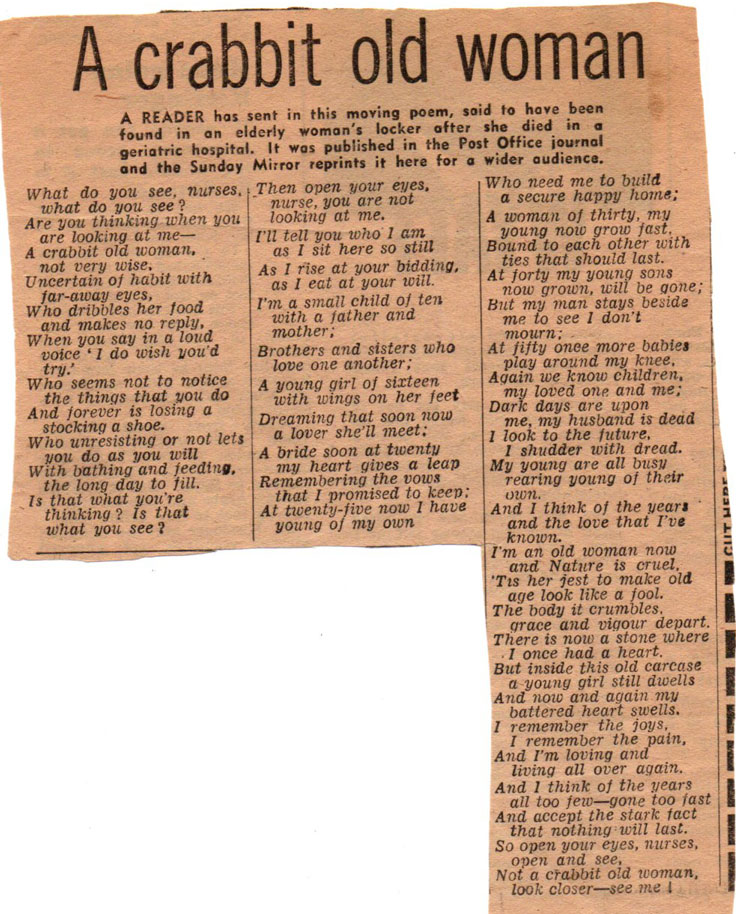
Well worth a read: I found this poem, carefully cut out of a Sunday Mirror, in her papers, spread around her seat on the couch in the living room in front of the tele. That was where she spent almost all her time. She had briefcases, file organizers, and there was always the coffee table: everything was in easy reach. Dust and cat hairs too: she loved her cats.
At the time, Marie-Helene’s and my family was busy blending, meaning going pretty much crazy, her two children, my two children and Charlie (less than a year old) all sorting themselves out in a forest southwest of Paris. The living were taking precedence, and I didn’t write anything then about losing mum at all, except in my capacity as co-executor of her estate.
I’ve been going through archives, reducing the number of boxes in the old stable, and recently discovered letters and other odds and ends collected and filed away back then. I took the time to read them (retirement and an empty nest do have their advantages!), and doing so gave me a big jolt. No-one gets over the loss of a parent very easily, although the passage of time helps distill the memories.
I easily go back to the last days we spent together, three or four days before she died. I had brought Nick (then nine) and Tom (seven) over to Marlow to visit her for the weekend – we made occasional visits together from France, although I tended to visit by myself by this point, because mum was so ill – and it was a fine visit. The boys did very well, behaving themselves, only a little bouncing off walls.
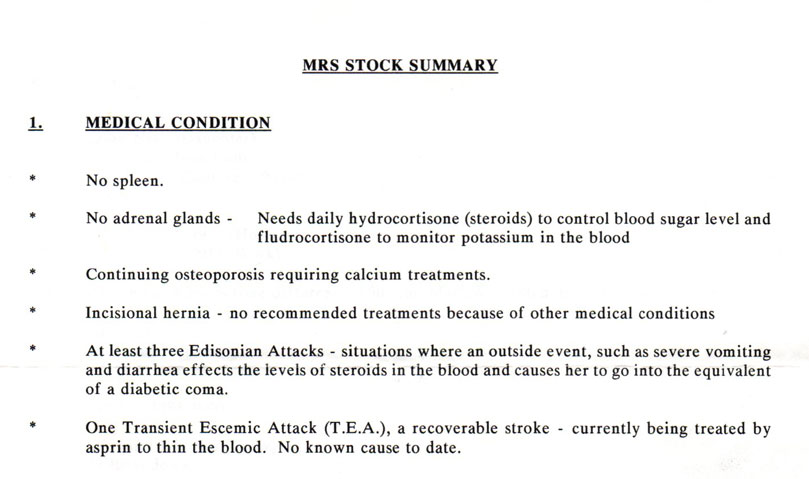
The first section of a detailed report that Sue prepared about her mum’s medical condition after dad died. That dates it around the end of 1983. Sue was dad’s co-executor: I was in New York. Most of the serious ailments which would color in grey the remaining years of mum’s life were already present.
She put us all up in a hotel in Maidenhead, perhaps five miles away from her home, because even with only two children out of five she now found collective visits tiring, and on the last evening, the Saturday, I returned to visit her again after putting the boys to bed. That was unusual – I didn’t normally leave them unattended – but something drew me back.
Mum, who been quiet and a tad withdrawn throughout the weekend, woke up as soon as I walked back into 18 South View Road. Her arm was very sore, an unusual and recent symptom, and so she called the doctor to check it out, one of her hobbies. The poor chap duly arrived at the house, as they did at that time in England, and basically asked what we wanted of him. That was a difficult question, and we passed on it. The local doctors did know how ill she was, but also that there was very little that they could do.
After he left, mum and I had one of our chats, full of life and laughter, as if it was 20 or 30 years earlier. I don’t remember what we talked about, just that it felt like her and my best times together, when I was in my late teens and early twenties. Maybe the chat lasted an hour, because it was already late and I was worried about the boys being alone. Maybe a bit longer, because we were both so happy that evening. She always said that we had the same sense of humor; we had been so close for so long.
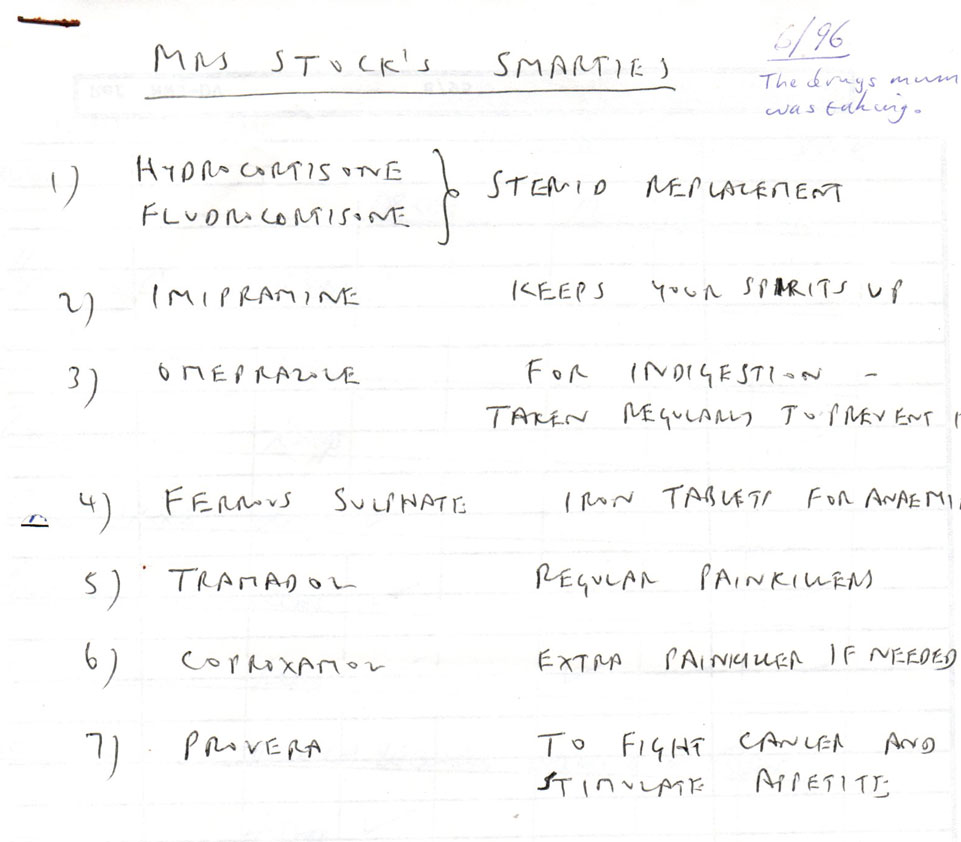
Someone had written this out for mum shortly before she died. It was with her papers on the coffee table. Her various long-lasting ailments were not what finally took her from us. That was cancer of her kidney, a late arrival. The only way that you can deduce it from this list of medicines is the “Extra painkillers.” She was in a lot of pain in the end, and her specialist happily gave her morphine.
I didn’t know that I would not see her alive again, but when I left for some reason couldn’t use the front door.
Leaving through the french windows in the living room, directly in front of her on her sofa in front of the tele, I looked back at her to smile an au revoir, and she looked at me “with a kind of wariness or bemused curiosity,” as I described it in a letter at the time, as if she was looking out of a tunnel. Never having seen that look before, I thought about it as I drove away, and again when Sue told me three days later that she had gone.
I have only ever seen that look one other time, in Santa Cruz on the face of Banane, the calico cat we had brought over from France. Banane died the night that she had that same bemused look, inside a tunnel.
Like mum, perhaps she knew that she was saying goodbye.
This is not the place to repeat all that mum did for her family and for Sue’s and my families. Her love for each of us, her efforts on all our behalves, should be visible elsewhere in these memoirs. In particular, her kindness during her last years – the annual passes to Disneyland outside Paris, the constant support – has already been written down here.
Rather, the documents and scraps that resurfaced recently bring up the sadness in her life as she aged, her solitude after her children had both emigrated, the years of coping with chronic illness, and her courage as the end approached. I mean this post as a kind of tribute to her, honest rather than saccharine, and perhaps a little off key.
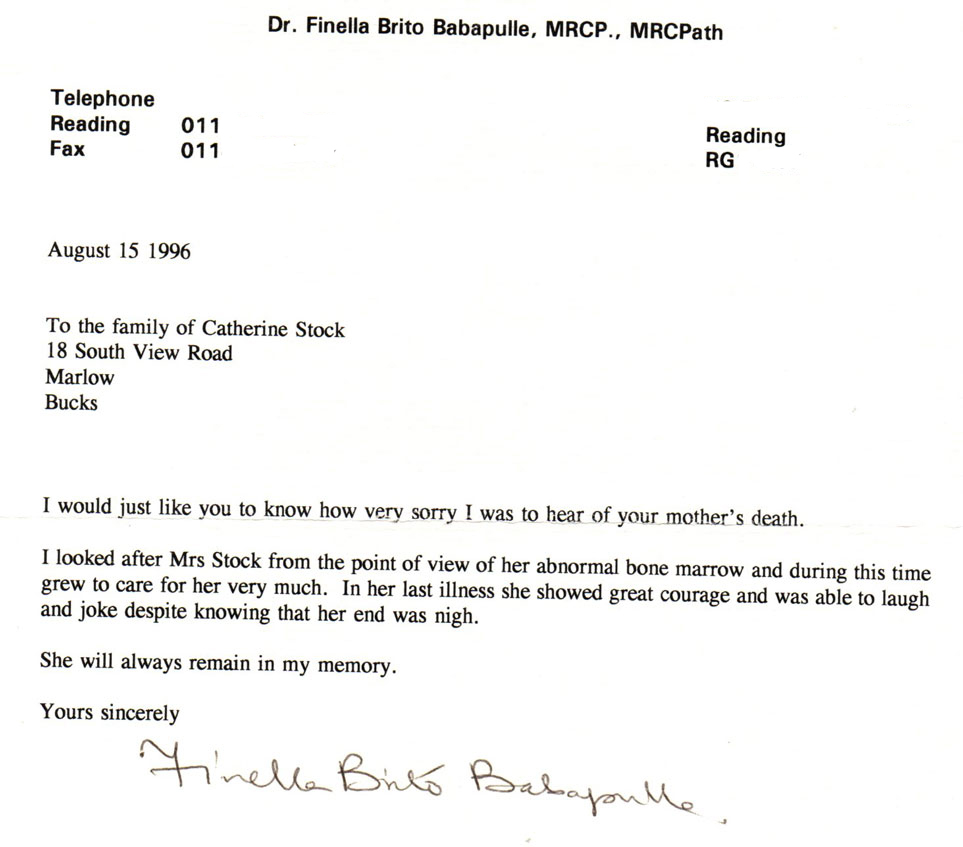
I never met this doctor, and suspect that Sue didn’t either. This letter, which arrived out of the blue, was a heart-warming confirmation of how mum acted during her last year. “Great courage,” “able to laugh and joke.” Go Missus!
First, the sickness unto death. Mum had been ill a lot during her life, more as the years advanced.
In contrast to dad, who kept his heart problems inside, she also talked about her health a lot: it was, understandably, one of her great interests. A family member’s ill health is hard on the whole family, and harder the more you hear about it. You always want to help a loved one feel better, and it’s frustrating when you can’t.
I suspect that it works the same way for doctors. Mum’s local medical group meant well, but her symptoms were so diverse and insistent, constant only in the regularity of their appearance and evolution, that the doctors in some sense gave up on her after referring her time and again to specialists. As did we in the family at times. So many symptoms, so little that we could do. At times, we felt that she was a bit of a hypochondriac. Maybe the local doctors did too.
But now when I look back, she had very real illnesses, which took extreme measures to fix. The first that I remember well was in around 1968 (she was about 40) when a specialist at Wycombe Hospital, Dr. Lord, recognized in a set of X-rays that she had three kidneys! And they had become tangled up inside her. That took four hours of surgery to fix, and Dr. Lord removed several pounds of waste products that had accumulated because of the knots. Until this happened, dad used to tease mum about the third child that she appeared to be carrying! The operation stopped that particular tease!
The TV Times, a weekly magazine, for July 22, two days before mum died. She had marked the programs that she didn’t want to miss, with a focus on soap operas!
Apparently unrelated symptoms proliferated over the years, until mum was sent to see a specialist at Bart’s Hospital in London, Doctor (later Professor) Michael Besser. He was an endocrinologist, on his way to becoming an eminent endocrinologist, and diagnosed her as having Cushing’s Syndrome, among other related illnesses.
I don’t remember when she started seeing Besser, as he was known around the house, in the late 1970s I think (she was around 50), or when he diagnosed her wide-ranging collection of ailments, but during her later years he asked her to come to classes that he taught at Bart’s on her illness(es) so that she could be introduced (shown) to students. She was not entirely comfortable being used as an example, and felt like a bit of a freak, but normally attended as requested.
No-one asks a hypochondriac to serve as a teaching specimem! And in retrospect I find it hard to understand why I ever doubted mum’s own reports of her health, but I did. We all did, even her local doctors.
There was perhaps something in our incapacity to help which turned us against her, at least on that level.
Mum with her Marlow friend Kay, Nick and Tom in 1990 on our sofabed in Paris. Kay helped mum on her occasional trips to visit us, and was a very good friend to her during her later years. She worked through many of mum’s steroid moods with her. I remember asking her, Kay, once why mum was so angry with the children and me during one visit. She looked perplexed, and said that she couldn’t understand it either, especially because mum always looked forward so much to our visits.
Living on steroids, as she did for 20 years or so, did not help her emotional life either, or make it easier for her family. I remember her berating me vigorously for not calling or visiting often enough. And this was when we lived in Paris, and I was visiting her every four or six weeks, sometimes with grandchildren! Which felt like I was doing my bit, but not for her.
She had lived alone since dad died in 1983.
A couple of mum’s absent friends, Moreen and Brian Newman, sent her this card asking to call on her after I let them know that she was not doing too well. A visit would have entailed a long drive for them, both in their late sixties, and they offered to make it without a second thought. She did have good friends.
Sue’s and mum’s relationship had become increasingly problematic since dad, the peacemaker, had died. Sue and her family had moved to California in 1987, the year that I moved from New York to Paris, and her visits to England became a source of great stress for both mother and daughter.
Sue dreaded her mum’s reproaches, which were frequent, and at times took the extreme step of not visiting her mum during one of her trips to England. Mum would always find out, of course, and was deeply hurt, not forgetting infuriated, each time that happened. Her reproaches became more ardent, and Sue again sought to avoid them. A vicious circle, which neither won.
Of course, mum was a lonely widow at the end. But not as lonely as she could have been. I was close enough to visit regularly, as were others in the extended family. Sue did visit from California: in fact, she was staying in mum’s house the week that she died, arriving after I had left to go back to Paris.
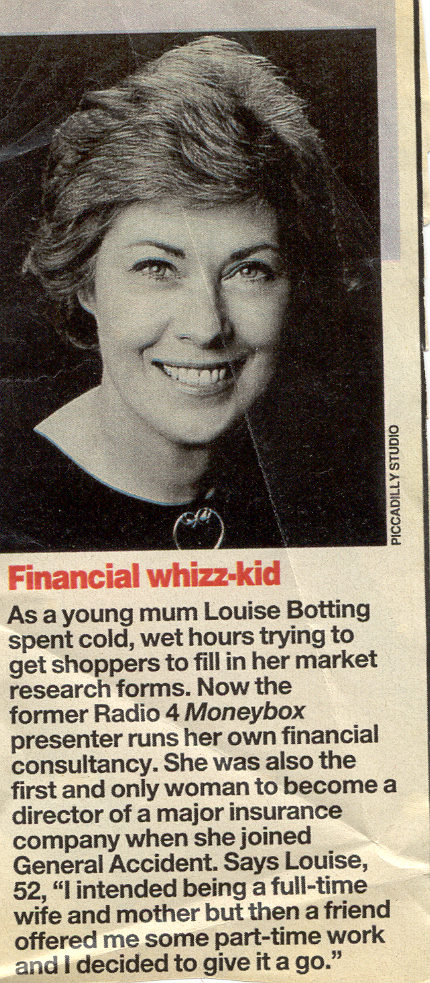
Why was this clipping on mum’s coffee table when she died? I find it sad.
Since her husband had died, 13 years before, mum had been adamant with us that dad had never strayed. But he had; we all knew it.
I doubt that he had strayed with Ms Botting, despite her obvious charm, because he had worked with her.
Rather, I suspect that the clipping was mum’s reminder to herself of the downside when she caught herself missing dad too much.
And mum still had a lot of friends, both locally in Marlow and further afield. Dad had left her with the means to visit family and friends herself even when she couldn’t drive any longer or even take the train. 150 miles each way in her favorite taxi was quite a feat! She maintained occasional trips like that almost until the end.
Each life’s emotional issues build up over time, more in sickness than in health. This is not the place to go into more of our various accumulated family issues: they would take too long to elaborate, and most of them have evaporated in the years since mum died. I no longer remember much in the way of specifics. Better to leave sleeping dogs lie.
Both Sue and I, and our respective families, were close enough to mum by the end. Somehow, what we had shared when we were all younger, healthier and less grating on each other, had been enough to weather the increasingly frequent storms. I’m very grateful for that, and hope to reproduce it with my own children.
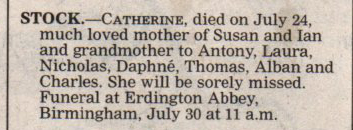
The end of a life, announced in the Daily Telegraph of July 26, 1996.
Mum herself, who had been warned by the doctors that her end was nigh, was telling everyone who would listen that she had lived a “complete life,” that was the phrase, and had no regrets.
Even at the end, she was focusing on the rest of us, because everyone who knew that she felt that way felt better because of that knowledge.
The funeral was held on July 30, Nick’s 10th birthday, in Erdington Abbey on the outskirts of Birmingham. Her mum and dad were buried there, near where they had lived and died, and she had provided in her Will that she would join them.
It was only when cousin Andrew Whitton drove his mother Margaret, mum’s oldest sister, away from the church right after the service, with no time to spend with any of us, that I realized that there was perhaps a problem with this arrangement.
Indeed, it turned out that there was not enough space remaining in the grave for all of mum’s siblings, and that all had not agreed with mum’s choice, although she thought that they had.
Typical! And typical of mum, the youngest sibling, to take advantage of her oldest sister by dying before her!
Sue’s and my respective families together near Marlow around the time of the funeral. Antony, the first grandchild, must have taken the photo.
The priest spent several minutes during the service trying to explain why mum’s prolonged suffering did not suggest that there is no God: no-one had told him that any of us were looking at things that way.
As he elaborated, I remembered Arthur Leff, my contracts professor in law school, explaining that an “Act of God” was something that no reasonable God would do!
And who is this charming fellow? No idea!
The name on the back of the photo, in mum’s writing, is John E. Broughton.
Another of mum’s coffee table photos, perhaps the most striking. I don’t remember ever seeing the photo, which must date from the war (WWII). That was when mum was single and in the ATS (the UK’s women’s army), from mid – 1944 until 1947 or ’48. She met dad not long after being demobbed, and they were married in 1949.
So she remembered her single life too, those years sitting all alone on the sofa.
I was delighted.
The real problem, when you get down to it, is that everyone dies, even your mum. And you can’t do anything about that.
Sue and I both shared with mum a taste for Kris Kristofferson, and we picked one of his songs to be played in the Abbey during the funeral service. We gave them a cassette of “Border Lord,” the album with the song on it: which was the last we saw of that cassette!
Here’s the first half of the song. The words alone will give you some idea of what we were feeling. I like to imagine that the river in the song was the Thames, flowing through Marlow, and that mum was there, sitting on the riverbank on a summer’s day in Higginson Park, with her skirt pulled up to her knees and her toes dipped in the cool water, when she died.
I never had no regrets, boys;not for nothing I’ve done.
I owed the devil some debts, boys,paid them all up but one.
And I don’t even regret the livingthat I’ll be leaving behind.
I’ve gotten weary of searchingfor something I couldn’t find.
I’m going down to the shadeby the river one more time,
And feel the breeze on my face before I die.
I’m gonna leave whatever’s left of my luck to the losers,
Mum’s family grave in 2002. Her mum Alice died when she was 10, her dad Fred when she was 17.
We went back to the land of the living as soon as the funeral was over.
In a former quaker factory town called Bournville, across Birmingham from the graveyard, is the original Cadbury factory, the site of my first memorable school excursion back in about 1962. Haslucks Green County Primary School took its pupils on a tour of a working chocolate factory!
It was Nick’s birthday, he was very sad about his grandmother dying, and the Cadbury factory had become Cadbury World, a theme park built around chocolate.
If you have to bury your mum, your grandma, what better place than a city with a theme park based on chocolate? And the children agreed!